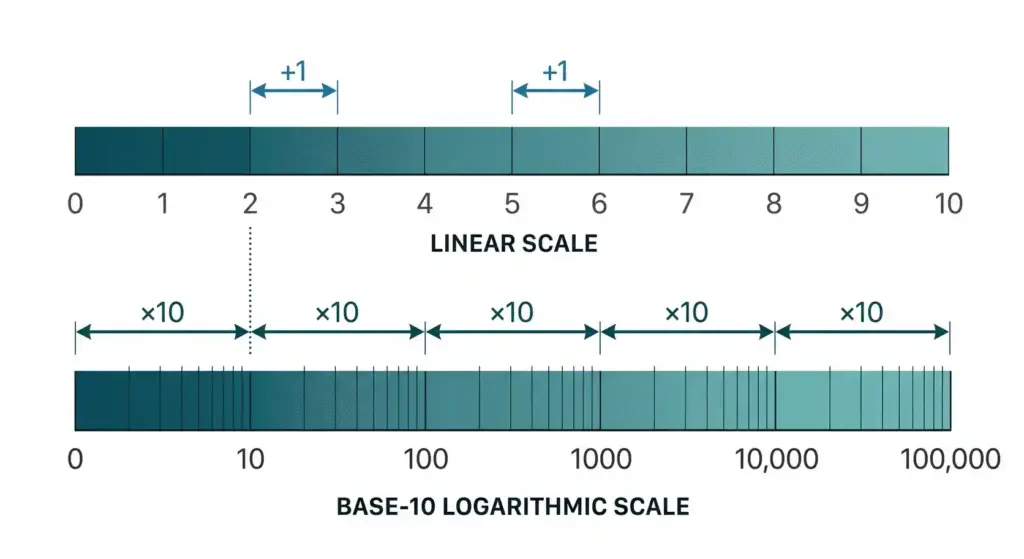
Logarithmic describes a scale or relationship in which equal increases represent multiplication by the same factor rather than addition by the same amount.
A logarithmic scale compresses very large ranges of values into a more manageable scale. On such a scale, moving up by one unit may represent a tenfold, hundredfold, or other fixed-factor increase, depending on the base of the logarithm.
Logarithmic scales are used in many areas of science and medicine, including measurements of sound intensity, acidity (pH), earthquake magnitude, and some measures of biological activity.
The decibel scale used in acoustics is logarithmic. Consequently, an increase of several decibels does not simply mean that the sound has become several units “louder” in a linear sense.
QUICK FACT
On a base-10 logarithmic scale, an increase of 1 unit means a 10-fold increase, while an increase of 2 units means a 100-fold increase.
COMMONLY CONFUSED WITH
- Linear: A linear scale increases by equal amounts; a logarithmic scale increases by equal ratios or factors.
- Decibel: a unit commonly used with logarithmic relationships in acoustics.
SEE ALSO