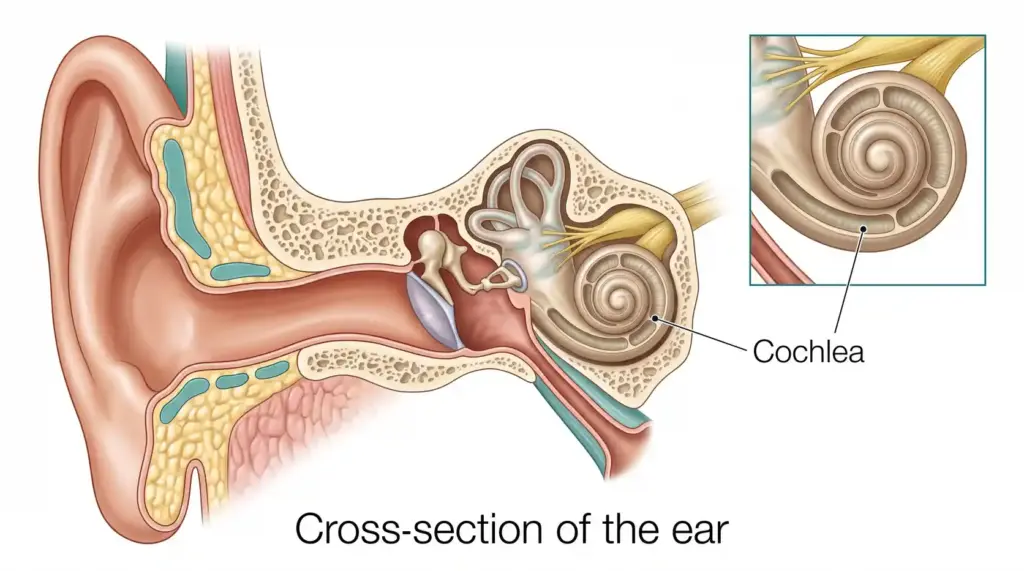
The cochlea is a spiral-shaped structure in the inner ear responsible for converting sound-induced mechanical vibrations into electrical signals that are transmitted to the brain for processing.
The cochlea is filled with fluid and contains specialised sensory cells called hair cells. When sound vibrations reach the cochlea, they produce movement within its internal structures. This movement stimulates the hair cells, which convert the mechanical activity into electrical signals that activate nerve fibres carrying hearing information toward the brain.
The cochlea contains the organ of Corti, the specialised sensory structure that houses the hair cells responsible for detecting sound. Different regions of the cochlea respond preferentially to different sound frequencies, allowing the auditory system to distinguish high-pitched sounds from low-pitched ones.
The cochlea can be stimulated through both air conduction and bone conduction. In air conduction, sound vibrations reach it through the usual pathway involving the outer ear, eardrum, and middle-ear ossicles. In bone conduction, vibrations transmitted through the bones of the skull stimulate the cochlea without relying on this usual sound-transmission pathway.
Damage to cochlear hair cells can result in sensorineural hearing loss. In humans, these sensory cells have a very limited ability to regenerate after permanent damage, meaning that hearing loss caused by their destruction is often permanent.
QUICK FACT
The cochlea is often compared to a tiny snail shell because of its spiral shape. In humans, it makes approximately two and a half turns around a central bony axis.
COMMONLY CONFUSED WITH
- Inner ear: The larger anatomical region that contains the cochlea, which is responsible for hearing, and the vestibular structures, which contribute to balance and spatial orientation.
- Auditory nerve: Carries hearing-related signals from the cochlea toward the brain. It is part of the neural pathway for hearing, not a structure within the cochlea itself.
- Bone conduction: The transmission of sound vibrations through the bones of the skull to stimulate the cochlea, rather than relying on the usual air-conduction pathway.
SEE ALSO