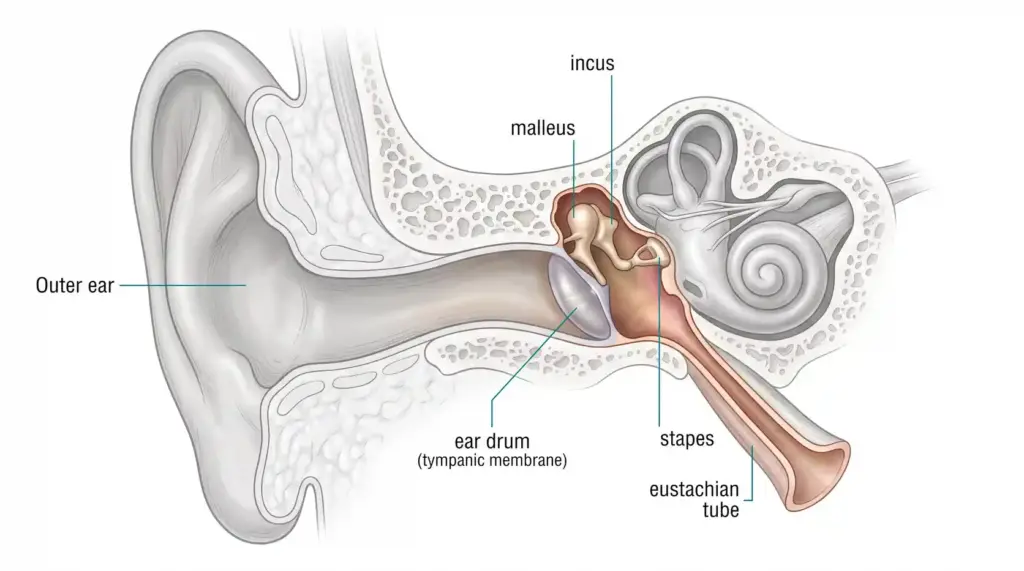
The middle ear is an air-filled space immediately behind the eardrum and before the inner ear. It contains three tiny bones, called ossicles, that transmit sound vibrations from the eardrum toward the inner ear.
When sound waves travelling through the air cause the eardrum to vibrate, the ossicles – malleus, incus, and stapes transmit these vibrations to the inner ear. The ossicles also help match the acoustic impedance between air and the fluid-filled inner ear, enabling sound energy to pass efficiently into the cochlea.
The middle ear connects to the nasopharynx (the area behind the nose and above the throat) through the Eustachian tube. This tube helps equalise air pressure on both sides of the eardrum, allowing it to vibrate properly.
The middle ear plays a central role in air conduction. In bone conduction, however, vibrations can stimulate the inner ear without relying on the usual sound-transmission pathway through the eardrum and ossicles.
QUICK FACT
- The ossicles are the smallest bones in the human body.
- Fluid accumulation or infection in the middle ear can interfere with sound transmission and cause conductive hearing loss.
COMMONLY CONFUSED WITH
- Outer ear: Collects sound and directs it toward the eardrum.
- Inner ear: Contains the cochlea and vestibular system, which are responsible for hearing and balance, respectively.
SEE ALSO