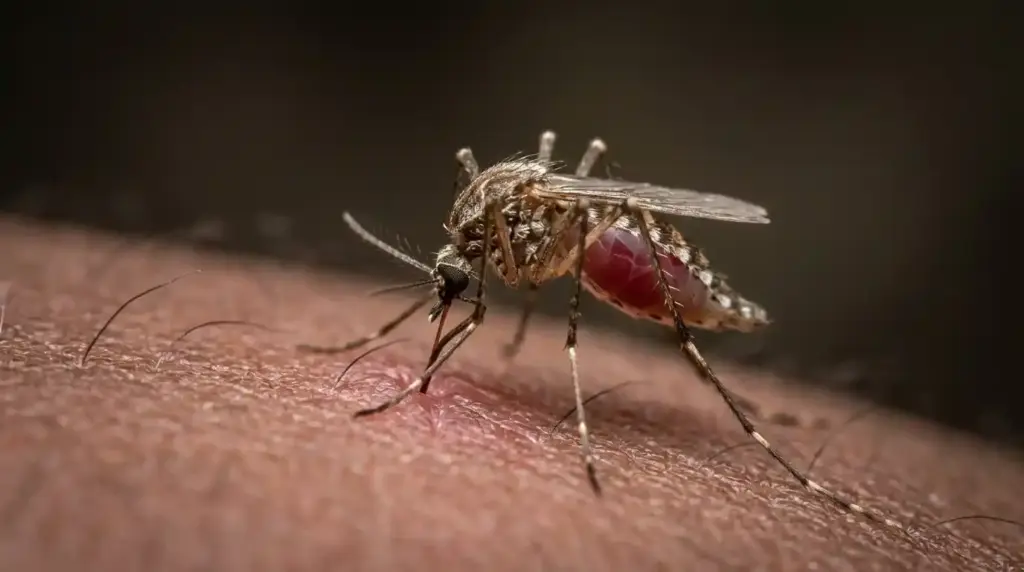
A mosquito is a small, flying insect belonging to the family Culicidae, many species of which feed on blood and can transmit disease-causing organisms to humans and other animals.
Mosquitoes undergo four stages of development: egg, larva, pupa, and adult. The immature stages of most species develop in water, although the type of water and the preferred breeding environment vary between species. Adult mosquitoes may feed on nectar and other plant sugars, while females of many species also take blood meals to obtain nutrients needed for egg production.
Some mosquitoes are vectors of important infectious diseases. Different species can transmit malaria parasites, dengue viruses, yellow fever viruses, Zika viruses, and other pathogens. However, not every mosquito carries a pathogen, and not every mosquito species transmits the same diseases.
Reducing mosquito-borne disease involves controlling mosquito populations, eliminating or managing breeding sites where appropriate, using effective insect repellents, installing intact window and door screens, and using insecticide-treated bed nets where recommended. The most effective measures depend on the mosquito species and the disease being prevented.
QUICK FACT
Only female mosquitoes of certain species take blood meals. Male mosquitoes generally feed on plant sugars and do not bite people for blood.
COMMONLY CONFUSED WITH
- Mosquito bite: The puncture and skin reaction that occur when a mosquito feeds. Most bites do not result in disease transmission.
- Vector: An organism that transmits a disease-causing agent from one host to another. Mosquitoes are vectors of several important infectious diseases.
- Malaria parasite: A parasite of the genus Plasmodium transmitted to humans by infected female Anopheles mosquitoes. Not all mosquitoes transmit malaria.
SEE ALSO
- Malaria
- Malaria Parasite
- Vector
- Vector-Borne Disease
- Dengue
- Yellow Fever
- Zika Virus
- Infection