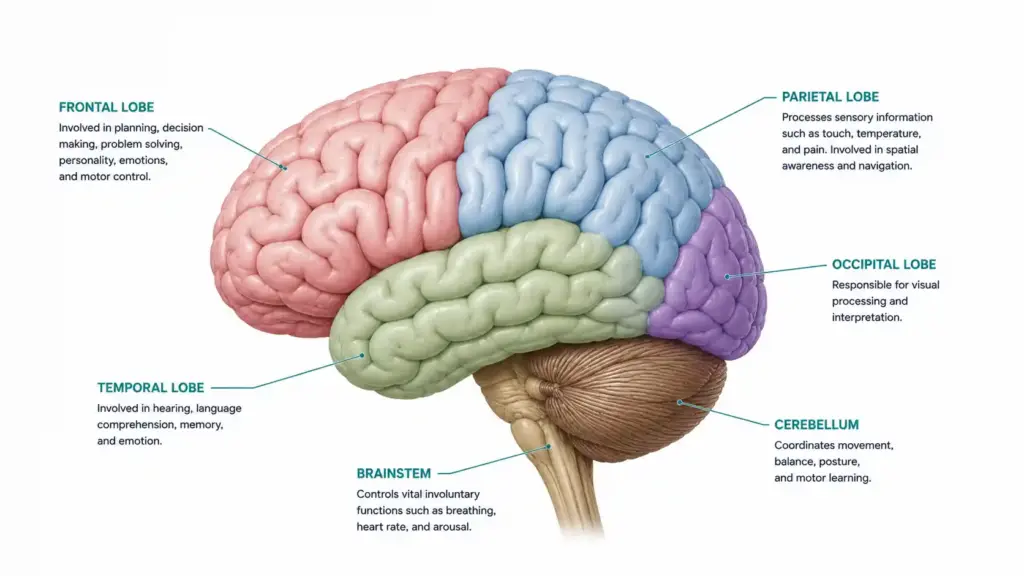
The brain is an organ located within the skull and continuous at its base with the spinal cord. It is the central organ of the nervous system, responsible for processing information and coordinating thought, sensation, movement, behavior, and many automatic functions of the body.
The brain contains billions of neurons and supporting cells organized into interconnected regions with specialized functions. It receives information from the body and the environment, processes and interprets that information, and generates responses that influence both conscious and involuntary processes. These include interpreting sensory input, controlling voluntary movement, regulating breathing and heart rate, and coordinating other automatic functions.
The brain also plays a central role in learning, memory, language, emotions, and decision-making. Together with the spinal cord, it forms the central nervous system.
QUICK FACT
The adult human brain contains approximately 86 billion neurons.
SEE ALSO