
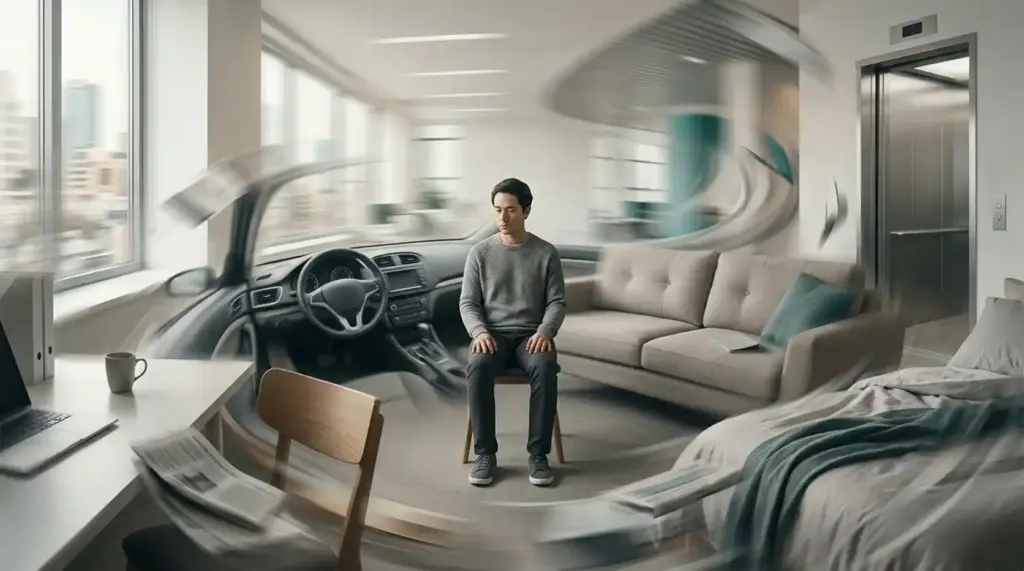
We have become masters of movement
without ever truly moving.

We travel farther,
faster,
more comfortably than those before us,
yet somehow our bodies have learned
the language of stillness.

A machine carries us to work,
and we call it progress.

The car waits outside the door,
a silent agreement between convenience and captivity.
The distance that once belonged to our feet
now belongs to four wheels.

A walk to the shop becomes unnecessary.
A stroll becomes a shortcut.
A few hundred steps become an inconvenience
we have successfully designed away.

We arrive at the building
and meet the stairs.

They ask for a little effort.
A little breath.
A little conversation with our muscles.

But the elevator opens its arms,
and we step inside.

Another victory for comfort.
Another defeat for movement.

We spend our days working hard.

The doctor sees patient after patient.
The teacher stands before a classroom.
The office worker answers endless questions.
The professional carries responsibility,
solves problems,
and gives everything to the day.

Yet the body remains seated.

Hours pass beneath us.
Chairs become silent companions.
Screens become our landscapes.

Our minds travel across continents,
but our bodies rarely leave the room.

We move from chair to chair,
from desk to car,
from car to couch,
from couch to bed.

And we wonder why exhaustion follows us
even when we have done so little physically.

The irony is almost invisible:

We live in a world built for motion,
yet we are becoming comfortable with stillness.

The only footsteps many of us truly own
are the ones between rooms at home,
the brief journeys between obligations,
the accidental moments when the body remembers
it was created to move.

Perhaps the problem was never that we stopped moving.

Perhaps we simply replaced movement
with the appearance of it.

Because motion is not only about distance travelled.
It is not measured by how many places we reach.

Sometimes, movement is the quiet choice
to walk when we could ride,
to climb when we could rise effortlessly,
to stretch when we could remain still.

The body does not ask for perfection.

It only asks to be remembered.

So today, before the elevator arrives,
before the engine starts,
before the chair welcomes us again—

let us ask:

Are we truly moving through life,
or are we only being carried through it?
About This Reflection
Sedentary in Motion reflects on a quiet paradox of modern life: we have gained extraordinary freedom to travel, work, communicate, and accomplish more, while many of us have gradually lost the ordinary movement that once accompanied those activities, contributing to what is now recognized as sedentary behavior.
The reflection is not an argument against cars, elevators, desks, technology, or convenience. These things can make life safer, more accessible, and more productive. The deeper question is what happens when convenience consistently removes the small physical movements that once formed part of everyday life.
A walk to the shop. A flight of stairs. Standing up between tasks. Walking across a room instead of sending a message. None of these seems significant on its own. Yet collectively, such moments can become part of how the body moves- or does not move- through an ordinary day.
This reflection asks us to notice that distinction: the difference between being in motion and actually moving our bodies.
The Medical Context
Sedentary behavior refers to waking activities performed while sitting, reclining, or lying down with very low energy expenditure. It is different from simply “not exercising.” A person may exercise regularly and still spend much of the remaining day sitting for work, commuting, watching television, or using a computer.
This distinction matters because prolonged sedentary time has been associated with poorer health outcomes, particularly when it occupies large portions of the day. Long periods of sitting can reduce opportunities for muscular activity and energy expenditure, while breaking up those periods with standing and light movement can provide additional activity throughout the day.
The answer is not necessarily to turn every ordinary activity into a workout. Movement can be much less dramatic than that. Walking short distances, taking the stairs when appropriate, standing periodically, doing household tasks, and interrupting long periods of sitting are all ways of bringing more physical activity into everyday life.
Exercise still matters, but health is not determined only by what happens during a scheduled workout. The hours between workouts matter too.
That is the medical idea beneath this reflection: the body does not experience movement only as exercise. It experiences the accumulation- or absence- of movement throughout the day.
Sedentary behavior is not the same as physical inactivity. A person can meet recommended levels of physical activity and still spend substantial time sitting. Conversely, increasing everyday movement does not require formal exercise every time. Both regular physical activity and reducing prolonged sedentary time are relevant to health.



No comments yet
Be the first to share your thoughts, clinical perspective, or questions on this topic.