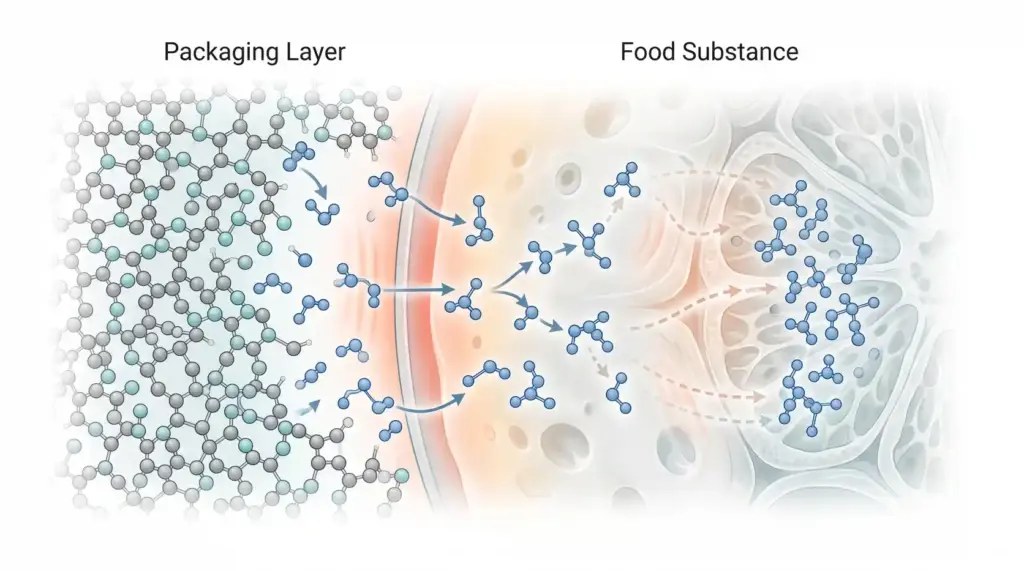
Chemical migration is the movement of chemical substances from a material into food or another substance that comes into contact with it.
In food packaging, migration can occur when substances present in packaging, coatings, adhesives, inks, or other food-contact materials move into food. This usually occurs at the molecular level, without any visible change in the packaging or food.
The amount that migrates depends on factors such as the substance’s chemical properties, the food, temperature, contact time, and the properties of the material.
Detecting a substance in food does not automatically mean that the food is unsafe. The amount present and the substance’s toxicological properties must also be considered.
QUICK FACT
Migration describes the movement of a substance; it does not by itself indicate whether the resulting exposure is harmful.
COMMONLY CONFUSED WITH
- Dose: the amount of a substance that reaches or is taken into the body.
- Exposure: contact with or intake of a substance by a person.
- Food Contamination: the presence of unwanted or harmful substances in food.
SEE ALSO