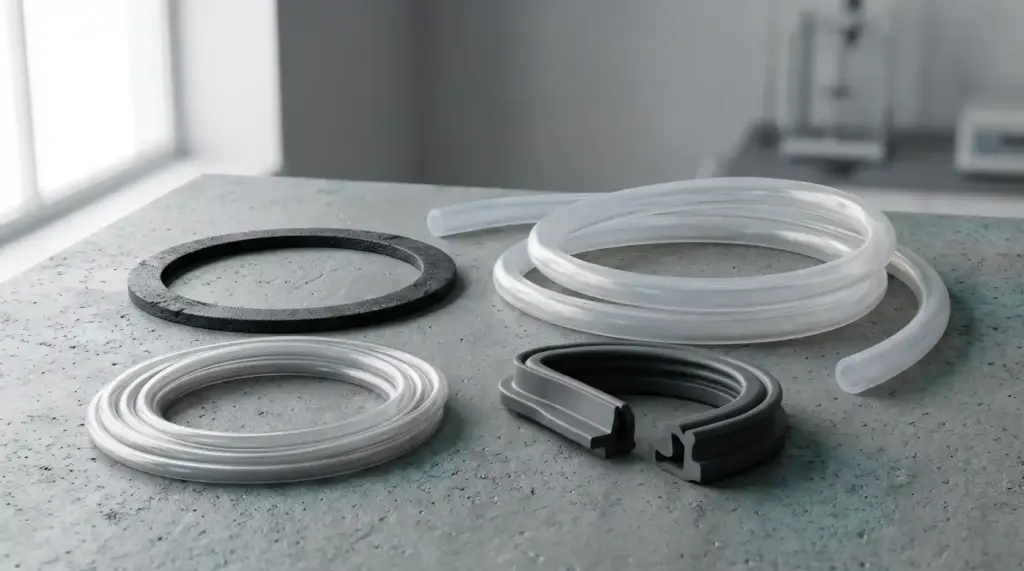
An elastomer is a polymeric material that can undergo substantial deformation and return approximately to its original shape when the applied force is removed.
Elastomers are commonly described as rubber-like materials because of their flexibility and elasticity. They are used in products such as seals, gaskets, tubing, gloves, flexible packaging components, medical devices, and various industrial products.
Some elastomers are natural, while others are synthetic. Their properties depend on their chemical structure, additives, processing, and intended use.
QUICK FACT
“Elastic” does not mean that an elastomer can stretch indefinitely. Every elastomer has limits beyond which it may deform permanently or break.
COMMONLY CONFUSED WITH
- Polymer: the broader category of materials made from long chains or networks of repeating molecular units. Elastomers are a type of polymeric material.
- Plastic: another broad class of polymeric materials, generally associated with different mechanical behavior.
Elastomers are a type of polymer, but their characteristic flexibility and elastic recovery distinguish them from many conventional rigid plastics.
SEE ALSO