

You may not notice noise pollution until you finally experience silence: the generator that never seems to stop, traffic that follows you into the night, music loud enough to make conversation impossible, construction that begins before sunrise, or the constant hum of a city that your brain has learned to ignore. But the fact that you can get used to a sound does not necessarily mean your body is unaffected by it. Noise pollution can interfere with sleep, concentration, communication, hearing, and psychological well-being, and prolonged exposure has been associated with cardiovascular and other health effects.
What Is Noise Pollution?
Noise pollution is unwanted, excessive, or harmful sound that interferes with normal human activities or has adverse effects on health and well-being.
Unlike air or water pollution, noise does not leave a visible residue. It disappears almost as soon as the sound stops. Yet its effects can persist because repeated exposure may interfere with sleep, increase stress responses, impair hearing, or contribute to longer-term health problems.
Noise becomes a health concern not simply because it is loud, but because of several interacting factors:
- How loud it is
- How long the exposure lasts
- How often it occurs
- Whether it happens during the day or at night
- How close you are to the source
- Whether the sound is continuous or intermittent
- Whether it is sudden or predictable
- Whether you can control or escape it
- The characteristics of the person exposed
This means that a moderately loud sound occurring repeatedly throughout the night can be more disruptive to health than a louder sound that occurs briefly during the day.
Noise pollution is more than “loud noise”
A common mistake is to define noise pollution simply as any sound above a particular decibel level.
There is no single universal number at which every sound suddenly becomes “pollution.”
Different health effects have different exposure thresholds, and environmental noise guidelines consider specific sources and patterns of exposure rather than relying on one number for every situation. WHO guidance addresses sources including road traffic, railways, aircraft, wind turbines, and leisure noise.
Noise pollution: Excessive, unwanted, or harmful environmental sound that interferes with normal activities or may adversely affect health and well-being.
Decibel (dB): A logarithmic unit used to describe sound level. Because the scale is logarithmic, a small numerical increase can represent a substantial increase in sound intensity.
Noise-induced hearing loss (NIHL): Hearing loss caused by exposure to excessively loud sound, either suddenly or over time.
Noise pollution is more than an annoyance
Noise becomes a health concern when it is unwanted, intrusive, excessive, or persistent enough to interfere with normal life.
That interference can take many forms: making conversation difficult, disrupting concentration, disturbing sleep, preventing relaxation, or making it harder to enjoy one’s home or surroundings.
The problem is not simply whether a sound is objectively loud. Its timing, duration, predictability, frequency, and context can all influence how disruptive it becomes.
A sound that seems harmless during the day can become highly intrusive at night.
Traffic outside a bedroom, construction near a school, aircraft passing overhead, or amplified music from a nearby venue may not damage hearing directly, yet repeated exposure can still interfere with sleep, concentration, or quality of life.
This is one reason environmental noise is treated as a public-health issue rather than merely a nuisance.
What the evidence says: Environmental noise can affect health through several pathways, and the health impact depends on factors such as sound level, duration, timing, and the type of noise exposure. WHO’s environmental-noise guidance addresses outcomes including sleep disturbance, annoyance, hearing impairment, cognitive effects, hypertension, and ischemic heart disease.
Noise affects more than hearing
Hearing is the most obvious way the body interacts with sound, but it is not the only one. The brain continuously monitors the acoustic environment, even when we are not consciously paying attention to it.
Persistent or unwanted noise can therefore affect the body through pathways that have little to do with direct injury to the ear.
For example, noise can interfere with sleep, trigger annoyance and stress responses, and make it harder to concentrate.
Repeated environmental noise exposure has also been associated with cardiovascular effects, including hypertension and ischemic heart disease. In children, transportation noise has been studied in relation to attention, learning, and cognitive performance.
This does not mean that every noisy environment will cause disease, or that every health effect associated with noise has been proven to occur in every individual. The evidence is stronger for some outcomes than others. What matters is that the health effects of noise extend beyond the question, “Could this damage my hearing?”
Noise is an environmental exposure, not just a hearing hazard.
You can be affected by noise even when it is not loud enough to cause immediate hearing damage. Sleep disruption, annoyance, impaired concentration, and longer-term health effects are part of the reason environmental noise deserves attention.
Why Does Noise Pollution Matter to Health?

The most obvious consequence of excessive noise is hearing damage. But hearing is only one part of the story.
The human body continuously monitors its environment. Unexpected or persistent noise can act as a stressor, particularly when it interferes with sleep or makes it difficult to concentrate, communicate, or relax.
Research reviewed by WHO links environmental noise exposure with several health outcomes, including:
- Sleep disturbance
- Annoyance and reduced quality of life
- Hearing impairment and tinnitus
- Cognitive effects, particularly in children
- Increased risk of cardiovascular disease
- Stress-related effects
- Some adverse metabolic and mental-health outcomes
- Adverse birth outcomes, although the strength of evidence varies by outcome
Noise pollution is easy to underestimate because its effects are often indirect.
A noisy environment may not cause an obvious injury today. Instead, it may repeatedly disturb sleep, increase stress, make concentration harder, or expose the ears to excessive sound. Over months or years, repeated exposure can become a meaningful health issue.
Where Does Noise Pollution Come From?

Noise pollution can occur almost anywhere people live, work, travel, or socialize.
Road traffic
Road traffic is one of the most important sources of environmental noise, particularly in cities.
Cars, buses, trucks, motorcycles, horns, sirens, and poorly maintained vehicles can create a persistent background of sound.
Traffic noise becomes especially important when homes, schools, workplaces, and hospitals are located close to busy roads.
Generators and machinery
In settings where electricity supply is unreliable, generators can become a routine part of daily life.
A generator may run for hours rather than minutes, meaning the issue is not necessarily how loud it sounds at one moment but the duration and repetition of exposure.
Industrial machinery, pumps, compressors, workshops, and other equipment can create similar problems.
Construction
Drilling, hammering, demolition, heavy machinery, and other construction activities can produce very high sound levels.
The timing matters too. Construction noise during normal daytime hours may be tolerated differently from the same noise repeatedly occurring during sleeping hours.
Music and entertainment
Concerts, nightclubs, parties, cinemas, religious gatherings, sporting events, and other amplified environments can expose people to very high sound levels.
The risk increases when loud sound is combined with long exposure periods and frequent repetition.
WHO estimates that more than one billion young people worldwide are at risk of hearing loss from unsafe recreational exposure to loud sound.
Personal audio devices
Headphones and earbuds can make loud sound highly accessible.
The danger is not simply owning or using headphones. The important variables are volume, duration, and frequency of exposure.
Aircraft and railways
People living near airports and railway lines may experience repeated environmental noise, including nighttime exposure.
Neighborhood noise
Noise from nearby homes, businesses, worship centers, parties, animals, alarms, loudspeakers, and other community activities can also become an environmental health concern.
Noise does not have to be continuous to affect you. Repeated interruptions can be particularly important for sleep because a person may experience multiple disturbances without fully remembering each one the next morning.
What Is a Decibel?
Sound level is commonly expressed in decibels (dB).
The decibel scale is logarithmic, which means that an increase in the number does not correspond to a simple linear increase in sound intensity.
For practical purposes, this is why comparing “60 dB versus 120 dB” as though 120 dB were simply twice as loud would be misleading.
WHO provides approximate examples ranging from around 30 dB for soft whispering to approximately 60 dB for normal conversation, 80 dB for a doorbell, 95 dB for a motorcycle, and 130 dB for a jackhammer.
Noise level is only part of the equation
A sound level that is tolerable for a short period may become harmful when exposure is prolonged.
For example, WHO’s safe-listening guidance gives an illustrative weekly exposure framework in which:
| Average sound level | Approximate weekly listening time |
|---|---|
| 80 dB | 40 hours |
| 85 dB | 12 hours 30 minutes |
| 90 dB | 4 hours |
| 95 dB | 1 hour 15 minutes |
| 100 dB | 20 minutes |
| 105 dB | 8 minutes |
| 110 dB | 2.5 minutes |
| 120 dB | 12 seconds |
These figures are particularly relevant to recreational listening and should not be interpreted as a guarantee that exposure below a particular level is completely risk-free.
What the evidence says: The risk of hearing damage depends on both how loud a sound is and how long a person is exposed to it. As sound levels increase, the amount of time considered safe decreases substantially. WHO’s safe-listening guidance therefore emphasizes reducing volume, limiting exposure time, taking listening breaks, and increasing distance from loud sources.
How Does Noise Pollution Affect the Ears?

The inner ear contains delicate sensory cells involved in hearing.
Excessively loud sound can overstimulate and damage these structures.
Temporary hearing changes
After exposure to loud sound, you may notice:
- Muffled hearing
- Difficulty understanding speech
- A feeling that sounds are unusually dull
- Ringing or buzzing in the ears
These symptoms may improve after the ears recover.
Permanent hearing damage
Repeated or sufficiently intense exposure can permanently damage the structures responsible for hearing.
Noise-induced hearing loss is often gradual. A person may not notice it immediately because the loss can begin subtly, particularly at higher frequencies.
Over time, someone may find it increasingly difficult to:
- Understand conversations in noisy places
- Hear high-pitched sounds
- Follow group conversations
- Hear someone speaking from another room
- Understand speech without asking people to repeat themselves
WHO notes that noise-induced hearing loss can be gradual and may go unnoticed until the effects become more obvious.
Tinnitus
Tinnitus is the perception of sound (often ringing, buzzing, humming, or hissing) without an external sound source.
Loud-noise exposure is an important cause of tinnitus.
Persistent tinnitus after loud-noise exposure should not simply be dismissed as “normal.”
What happens inside the ear after loud noise?
Sound does not simply travel into the ear and stop there.
Vibrations pass through the outer and middle ear and eventually reach the cochlea, a small, spiral-shaped structure in the inner ear.
Inside the cochlea are specialized sensory hair cells that convert mechanical vibrations into electrical signals that travel through the auditory nerve to the brain.
The organ of Corti is the specialized sensory structure within the cochlea that contains these important hair cells.
Very loud sound can place these delicate structures under considerable stress.
After a loud concert, for example, a person may notice muffled hearing or ringing and buzzing in the ears. WHO explains that this can result from temporary fatigue of the sensory cells, and hearing may improve as the cells recover.
The organ of Corti: Think of the organ of Corti as one of the cochlea‘s key sound-sensing structures. Its sensory hair cells help turn the mechanical vibrations of sound into signals that the brain can interpret.
Can hearing recover after loud noise?
Sometimes it can.
After a sufficiently loud exposure, hearing may temporarily become muffled and the ears may ring or buzz.
These changes can improve after the exposure ends as the sensory cells recover.
This is one reason someone might leave a loud concert feeling as though their hearing has been damaged, only to find that their hearing seems normal again a day or two later.
But there is an important distinction:
Feeling normal again does not necessarily mean that the exposure was harmless.
WHO notes that temporary hearing loss or tinnitus can occur after loud sound, while regular or prolonged exposure can permanently damage sensory cells and other structures of the inner ear.
NIDCD similarly notes that hearing may return to normal after a day or two following loud exposure, while research suggests that permanent damage may still have occurred even when noticeable hearing loss is not immediately apparent.
What the evidence says: Temporary hearing loss and tinnitus can improve after loud-noise exposure as the ear recovers. However, repeated or prolonged exposure to loud sound can cause permanent damage. A return to apparently normal hearing should therefore not be interpreted as proof that an exposure caused no lasting injury.
How repeated noise exposure gradually damages hearing
Permanent hearing loss from noise does not always happen dramatically. Often, it develops gradually.
The risk depends on several characteristics of the exposure: how loud the sound is, how long it lasts, how close you are to the source, and how often the exposure occurs.
A very loud sound can cause injury after a single exposure, while less intense but repeated exposure can gradually damage the inner ear over time.
This is why someone may spend years working around machinery, attending loud events, using headphones at high volume, or regularly being exposed to loud music without noticing an obvious problem after each individual exposure.
The effects can accumulate, and early hearing changes may be subtle enough to ignore.
The first signs may not be that the world suddenly becomes quiet. Instead, sounds may become less clear or more muffled.
High-pitched sounds may become harder to hear, conversations may be more difficult to follow in crowded places, and a person may begin turning up the volume on the television or phone.
Tinnitus may also occur.
Noise-induced hearing loss often develops so gradually that people may not realize it is happening until communication becomes noticeably difficult.
Why does the damage become permanent?
The sensory hair cells of the human inner ear are remarkably delicate, but they have a major limitation: when they are destroyed by excessive noise, they do not regenerate.
Damage to these cells and their associated structures can therefore result in permanent sensorineural hearing loss.
The process is more complicated than simply saying that loud sound “wears out” the ear.
Intense sound can produce mechanical and metabolic stress within the cochlea, and sufficiently severe exposure can damage the sensory structures involved in hearing.
The result may be a lasting reduction in the ear’s ability to detect and transmit certain sounds.
The damage is often first noticeable at higher frequencies. As exposure continues and hearing deteriorates, understanding speech, particularly when there is background noise, can become increasingly difficult.
Why chronic noise can make hearing seem to “age” faster
Repeated noise exposure can produce hearing deterioration that resembles some of the communication difficulties associated with aging.
The important difference is that noise-related hearing damage is preventable: reducing exposure can reduce the risk of further injury.
NIDCD emphasizes that noise-induced hearing loss can happen at any age and that the effects of loud sounds can accumulate over a lifetime.
This is particularly important because age and noise exposure can occur together.
Someone may attribute difficulty understanding speech to “just getting older” when years of occupational, recreational, or environmental noise exposure may also have contributed.
Hearing difficulty is not necessarily an inevitable part of getting older. Age-related changes and noise-related hearing damage can coexist, but preventing excessive noise exposure throughout life can help preserve hearing.
Do not ignore persistent symptoms after loud-noise exposure.
Temporary ringing or muffled hearing can occur after loud sound and may improve as the ears recover. However, persistent tinnitus, ongoing hearing difficulty, sudden hearing loss, or other significant changes in hearing deserve medical assessment rather than being assumed to be temporary.
Noise Pollution and Sleep

Sleep is one of the most sensitive parts of daily life to environmental noise.
Unwanted sound can make it harder to fall asleep, cause brief or complete awakenings, and interrupt the normal progression of sleep.
Even when you do not fully wake or remember the disturbance the next morning, repeated noise can still reduce the restorative quality of sleep.
Nighttime noise can be particularly disruptive because the surrounding environment is usually quieter, making intrusive sounds more noticeable.
Traffic, aircraft, trains, construction, nightlife, loud neighbors, barking dogs, and other community sounds can interrupt sleep even when they would seem relatively minor during the day.
The consequences can extend beyond the night itself. Repeated sleep disturbance may contribute to daytime tiredness, impaired concentration, irritability, and reduced quality of life.
This is one reason environmental-noise guidelines pay particular attention to nighttime exposure.
However, not every nighttime sound is harmful, and the effect depends on factors such as sound level, duration, frequency, timing, and individual circumstances.
The goal is therefore not to eliminate every sound from the environment, but to reduce unnecessary and disruptive exposure, particularly during the hours when people need to sleep.
What the evidence says: Sleep disturbance is one of the better-established health effects of environmental noise. Noise can interfere with sleep onset, cause awakenings, and affect sleep quality. The WHO Environmental Noise Guidelines specifically address nighttime environmental noise because of its potential effects on sleep and health.
If noise is disturbing your sleep:
- Close windows when outdoor noise is highest, if practical.
- Move the bed away from the noisiest wall or window where possible.
- Use appropriate earplugs if they are comfortable and safe for you.
- Consider steady, low-level background sound to mask intermittent noise.
- Reduce avoidable household noise at night.
- If nighttime noise is coming from a persistent external source, consider community or environmental measures rather than relying only on personal coping strategies.
If someone says, “I sleep through the noise, so it cannot be affecting me,” that conclusion may be too simplistic.
Sleep is not an all-or-nothing state. Environmental noise can disturb sleep without producing a fully remembered awakening. Repeated disruption may still affect how restorative the sleep is.
Noise Pollution and Stress

Persistent unwanted noise can become a psychological stressor.
The reaction may include:
- Irritability
- Frustration
- Difficulty concentrating
- Feeling tense or constantly alert
- Reduced ability to relax
- Annoyance
The response is influenced by more than sound level alone.
A sound that someone finds threatening, uncontrollable, unpredictable, or intrusive may be more stressful than an equally loud sound that is expected and voluntarily chosen.
WHO‘s evidence reviews describe biological pathways involving stress responses in the relationship between environmental noise and cardiovascular and metabolic effects.
Can Noise Pollution Affect the Heart?

Increasing evidence links long-term environmental noise exposure with cardiovascular effects.
Research has associated environmental noise with increased risk of conditions including hypertension and ischemic heart disease.
The proposed pathway is not simply “noise damages the heart.”
Instead, repeated noise exposure, particularly when it disrupts sleep or produces chronic stress responses, may contribute to physiological changes involving the nervous system, stress hormones, blood pressure, and vascular function.
What the evidence says: Long-term exposure to environmental noise has been associated with cardiovascular outcomes including hypertension and ischemic heart disease. Proposed pathways include repeated stress responses, sleep disturbance, autonomic nervous-system activation, and effects on cardiovascular function.
Important: An association observed at the population level does not mean that every individual exposed to environmental noise will develop cardiovascular disease.
Noise Pollution and Children

Children deserve particular attention because their brains and learning environments are still developing.
Environmental noise can interfere with:
- Attention
- Reading
- Memory
- Concentration
- Classroom communication
- Learning
WHO has reported evidence linking chronic noise exposure with impaired cognitive performance in children, particularly in relation to transportation noise.
A child who cannot clearly hear a teacher because of persistent background noise may not simply be “distracted.” Repeated interference with communication and concentration can affect learning.
What the evidence says: Environmental noise can interfere with children’s attention, concentration, and cognitive performance. Transportation noise has been particularly studied in relation to children’s learning and cognitive outcomes.
Children are not simply smaller adults. Their developmental stage, learning environment, sleep requirements, and longer lifetime exposure make protection from excessive noise particularly important.
Noise Pollution During Pregnancy

Noise exposure during pregnancy is an area of ongoing research.
WHO’s environmental noise guidance considers adverse birth outcomes among the health outcomes investigated in relation to environmental noise. However, the evidence is not equally strong for every outcome or every type of exposure.
Living near a noisy road, for example, does not mean that an adverse pregnancy outcome will occur. But reducing unnecessary and excessive environmental noise remains a sensible population-health goal.
Evidence concerning some pregnancy and birth outcomes remains less certain than the evidence for established effects such as sleep disturbance and annoyance. Noise exposure should therefore not be presented as a guaranteed cause of adverse pregnancy outcomes.
Who Is Most Vulnerable to Noise Pollution?

Anyone can be affected by excessive noise, but some people may be particularly vulnerable.
Risk factors include:
- Living near busy roads
- Living near airports or railway lines
- Working in noisy environments
- Regular exposure to industrial machinery
- Frequent attendance at loud entertainment venues
- Regular use of high-volume headphones or earbuds
- Night-shift work
- Sleeping in noisy environments
- Living in poorly insulated housing
- Young age
- Older age
- Existing hearing problems
- Limited ability to control or escape the noise
WHO also notes that socioeconomic factors can influence noise exposure, with people who have fewer housing choices potentially having less ability to avoid noisy environments.
Higher-risk pattern:
High sound + long duration + frequent exposure + little opportunity to escape = greater concern.
The exact risk still depends on the type and intensity of exposure.
Is All Noise Harmful?

No.
This is an important distinction.
Sound is a normal part of human life. Conversation, music, laughter, traffic, children’s play, and community activity are not inherently unhealthy.
The concern is excessive or unwanted exposure, particularly when it interferes with hearing, sleep, communication, concentration, or health.
“If noise does not hurt my ears, it cannot be harmful.”
Noise can affect sleep, stress, concentration, and cardiovascular health without causing immediate ear pain. Hearing damage is only one possible consequence of excessive environmental noise.
“You eventually get used to noise.”
You may become less aware of a recurring sound, but reduced awareness does not necessarily mean the exposure has become biologically irrelevant.
“Only very loud music damages hearing.”
Hearing risk depends on both loudness and duration. Repeated exposure to moderately high sound levels can also become harmful.
“Noise pollution is mainly an urban annoyance.”
Environmental noise is a public-health issue because it can affect sleep, hearing, cognitive function, psychological well-being, and cardiovascular health.
Noise Pollution vs Noise-Induced Hearing Loss

These terms are related but not interchangeable.
Noise pollution refers broadly to harmful or unwanted environmental sound.
Noise-induced hearing loss is a specific health condition caused by excessive noise exposure.
A person can therefore experience harmful noise exposure without yet having measurable hearing loss.
For example, persistent nighttime traffic may primarily affect sleep, while repeated exposure to loud machinery may pose a greater immediate risk to hearing.
How Can You Protect Yourself From Noise Pollution?

You cannot always control your environment, but you can often reduce your exposure.
1. Increase your distance from loud sources
Distance matters.
If you are attending an event with amplified sound, moving farther away from speakers can reduce your exposure.
2. Reduce the volume
For headphones and earbuds, lower volume is one of the simplest protective measures.
WHO recommends keeping device volume down and suggests staying below an average of 80 dB when using a sound-monitoring app.
3. Reduce exposure time
A high sound level becomes more concerning the longer you remain exposed.
Take breaks from loud environments.
4. Give your ears quiet periods
After prolonged loud exposure, spending time in a quieter environment gives your auditory system an opportunity to recover from temporary fatigue.
5. Use appropriate hearing protection
Earplugs or earmuffs can be useful when loud exposure cannot be avoided, particularly in occupational or recreational settings.
Hearing protection should not be used as an excuse to remain unnecessarily close to an extremely loud source.
6. Improve your sleeping environment
Where practical:
- Close windows facing major traffic sources.
- Improve sound insulation.
- Move the bed away from a noisy wall or window.
- Use quieter rooms for sleeping.
- Address avoidable nighttime noise at its source.
7. Do not underestimate headphones
Noise-canceling headphones can sometimes help by reducing the need to increase volume in noisy environments. But noise cancellation does not make unlimited volume safe.
The volume still matters.
8. Protect children
Children should be kept away from unnecessarily loud environments and should have age-appropriate volume limits on personal audio devices.
WHO’s safe-listening framework uses a lower reference exposure for children than for adults.
What the evidence says: Reducing volume, limiting exposure time, increasing distance from loud sources, taking breaks, and using appropriate hearing protection are central strategies for reducing potentially harmful sound exposure. WHO incorporates these principles into its safe-listening recommendations.
Remember the three variables:
Lower the volume. Shorten the exposure. Increase the distance.
You do not always need specialized equipment to make a meaningful reduction in noise exposure.
What About Noise-Canceling Headphones?
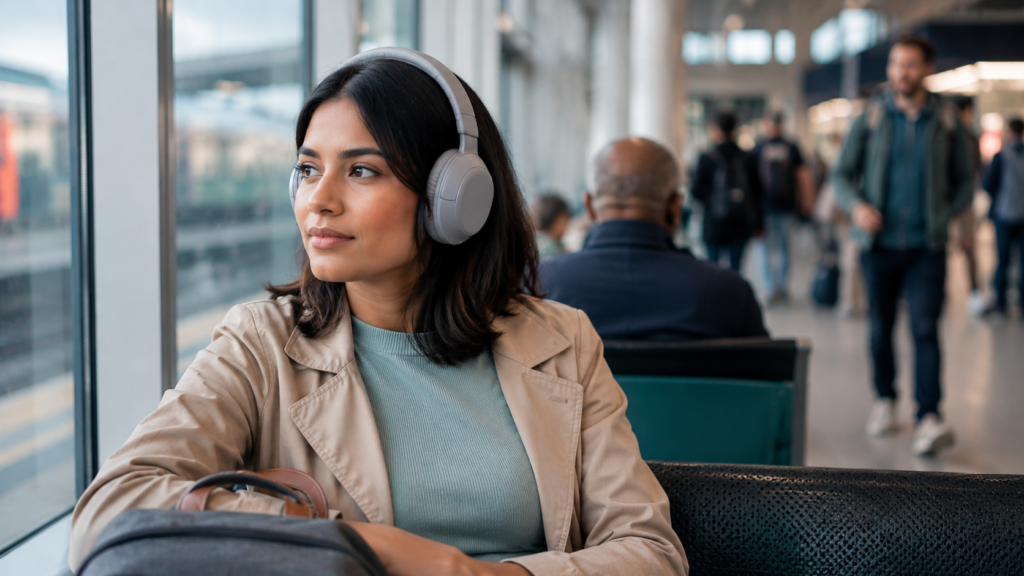
Noise-canceling headphones can be helpful, but they are not a license to turn up the volume.
In a noisy environment, reducing background noise may allow a person to listen comfortably at a lower volume.
That is potentially protective.
But listening at very high volume for prolonged periods can still damage hearing even when the headphones have excellent noise cancellation.
When Should You Get Your Hearing Checked?

Consider professional hearing assessment if you experience:
- Persistent ringing or buzzing in the ears
- Difficulty understanding speech
- Increasingly frequent requests for people to repeat themselves
- Difficulty hearing in restaurants or crowded places
- Trouble hearing high-pitched sounds
- A persistent feeling of blocked or muffled hearing
- Noticeable decline in hearing after repeated loud-noise exposure
- Difficulty following conversations despite being able to hear that someone is speaking
WHO specifically advises seeking professional help for persistent tinnitus or difficulty hearing high-pitched sounds or following conversations.
Seek prompt medical assessment if you develop sudden hearing loss, particularly if it occurs in one ear, rather than assuming that it is simply the result of noise exposure.
Sudden hearing loss can require urgent evaluation.
What Can Communities Do About Noise Pollution?

Individual behavior matters, but noise pollution cannot be solved entirely by telling individuals to wear earplugs.
Much of environmental noise is created by systems:
- Transportation
- Urban planning
- Construction
- Industry
- Entertainment venues
- Housing design
- Road infrastructure
- Generator use
- Public-address systems
WHO emphasizes that controlling noise at its source can be more effective than relying entirely on measures that require individuals to change their behavior or protect themselves indoors.
This makes noise pollution an environmental-health and public-policy issue as much as a personal-health issue.
What the evidence says: Reducing noise at its source and through environmental or engineering controls can be more effective than relying entirely on individuals to protect themselves after exposure has already occurred. WHO’s environmental-noise guidance therefore emphasizes interventions involving transportation, urban planning, building design, and other environmental measures.
A person living beside a major highway cannot solve traffic noise by simply “ignoring it.”
Similarly, telling a factory worker to protect their ears does not remove the employer’s responsibility to control hazardous noise exposure.
The best hierarchy is often:
Control the noise at the source → reduce transmission → protect the exposed person.
Common Mistakes People Make About Noise Pollution
1. Waiting until hearing loss appears
Hearing damage can develop gradually. Prevention is easier than restoring damaged sensory structures.
2. Thinking occasional loud exposure is automatically harmless
A single exposure can be hazardous if the sound is extremely intense. Repeated exposure also accumulates risk.
3. Focusing only on volume
Duration, frequency, timing, distance, and individual susceptibility matter too.
4. Turning up headphones to overcome background noise
This can increase hearing exposure substantially.
5. Ignoring tinnitus
Persistent ringing or buzzing after repeated loud exposure deserves attention.
6. Treating sleep disruption as merely an inconvenience
Repeatedly disturbed sleep is a health issue, not simply a comfort issue.
7. Assuming that getting used to a noise means it is harmless
Habituation can reduce conscious awareness without eliminating exposure.
What We Still Do Not Know
Noise research has advanced considerably, but important questions remain.
The evidence is stronger for some noise-related outcomes than others.
There is substantial evidence linking environmental noise with sleep disturbance, annoyance, hearing effects, and cardiovascular outcomes. Other proposed effects, including some mental-health, metabolic, and pregnancy-related outcomes, have more variable or developing evidence depending on the exposure and outcome studied.
This distinction matters.
Good health communication should not turn every statistical association into a guarantee of disease.
The right message is not that every noisy environment will make you sick.
It is that unnecessary and excessive noise is a modifiable environmental exposure with real health consequences.
A Simple Way to Think About Your Noise Exposure
You can think about noise risk using five questions:
1. How loud is it?
Higher sound levels generally mean greater hearing risk.
2. How long am I exposed?
The longer the exposure, the greater the potential risk.
3. How often does it happen?
Repeated exposure matters.
4. Does it interfere with sleep or daily activities?
Noise that repeatedly disrupts sleep, communication, or concentration deserves attention even when it does not feel painfully loud.
5. Can I reduce the exposure?
If the answer is yes, even modest reductions may be worthwhile.
Question & Quick Answer
Is noise pollution harmful?
Yes. Excessive environmental noise can affect hearing and sleep and has also been associated with stress, impaired cognitive performance, and cardiovascular health effects. The risk depends on factors such as sound level, duration, frequency, timing, and the characteristics of the exposed person.
Frequently Asked Questions About Noise Pollution
Is noise pollution bad for your health?
Yes. Excessive environmental noise is associated with several health effects, including sleep disturbance, hearing impairment, tinnitus, annoyance, cognitive effects, and cardiovascular health risks.
What is the most common effect of noise pollution?
The answer depends on the type of exposure. Hearing problems are particularly important with loud recreational or occupational sound, while environmental noise is also strongly associated with sleep disturbance and annoyance.
Can noise pollution cause high blood pressure?
Chronic environmental noise exposure has been associated with increased cardiovascular risk, including hypertension. However, exposure does not mean that an individual will necessarily develop high blood pressure.
Can noise pollution cause hearing loss?
Yes. Repeated or sufficiently intense exposure to loud sound can cause noise-induced hearing loss, which may be permanent.
Can noise pollution affect sleep even if I do not wake up?
Yes. Environmental noise can disturb sleep without producing a clearly remembered full awakening.
Is traffic noise a form of noise pollution?
Yes. Road traffic is one of the major sources of environmental noise, especially in urban areas.
Are children more vulnerable to noise?
Children can be particularly affected because noise can interfere with learning, attention, communication, and sleep.
Are headphones safe?
Headphones are not inherently unsafe. The important factors are volume, duration, and frequency of use. WHO recommends keeping listening levels down, limiting exposure time, and taking breaks.
How loud is too loud for headphones?
There is no single number that guarantees zero risk, but WHO’s safe-listening framework uses 80 dB for up to 40 hours per week as a reference exposure for adults and 75 dB for 40 hours per week for children or sensitive users. As sound levels increase, the recommended exposure time decreases rapidly.
Can noise pollution affect mental health?
Noise can contribute to annoyance, stress, sleep disturbance, and reduced psychological well-being. Research into specific mental-health disorders is more complex, and associations should not automatically be interpreted as direct causation.
What is the best way to prevent noise pollution?
At the individual level, reduce volume, exposure duration, and proximity to loud sources. At the community level, reducing noise at its source, through transport planning, engineering controls, building design, regulation, and other environmental measures, is generally more effective than relying only on personal protective behavior.
Noise pollution is not simply a problem of annoying sounds. Excessive or persistent noise can interfere with sleep, hearing, communication, concentration, and well-being, while long-term exposure has been associated with cardiovascular and other health effects.
Protecting yourself does not require living in complete silence. Start with the basics: reduce unnecessary volume, shorten exposure time, increase distance from loud sources, protect your ears when needed, and take persistent hearing symptoms seriously.
And when the source of the problem is traffic, construction, industry, generators, or community infrastructure, the solution cannot rest entirely on the individual. Healthy environments require healthy soundscapes.


No comments yet
Be the first to share your thoughts, clinical perspective, or questions on this topic.