

It wasn’t his first malaria. He was young, otherwise healthy, and had been through the illness before. This time, however, the malaria parasite had been confirmed in his blood, and he began treatment as expected. When he did not improve as quickly as he hoped, he changed medicines. Then he changed them again. Different brands, different tablets, prescribed medicines, over-the-counter products, even injections, each one promising to be the treatment that finally worked. Somewhere along the way, he began to suspect that some of the medicines were not genuine, raising the possibility of fake malaria medicines. But he had no way of knowing for certain. And while he searched for a medicine he could trust, the malaria was still there.
When Treatment Becomes a Search
At first, his reasoning was simple.
He had malaria.
He took medicine.
He remained unwell.
So perhaps the medicine had not worked.
He tried another one.
When that did not produce the improvement he expected, there was another possibility: perhaps the brand was not right. Perhaps another medicine would work better. Perhaps an injection would work faster.
With every passing day, another option seemed available.
A different brand.
A different tablet.
Another recommendation.
Another person with an opinion.
What began as treatment gradually became a search for treatment.
And the more medicines he tried, the harder it became to know whether he was experiencing treatment failure, an inadequate regimen, a poor-quality medicine, an incomplete course, or something else entirely.
He Was Not Refusing Treatment
He was not someone who had decided that malaria was harmless.
He was not refusing medical care.
He was not deliberately ignoring the diagnosis.
He was trying to get better.
That distinction matters.
From the outside, repeatedly changing medicines can look careless or irrational. From inside the experience of persistent fever and uncertainty, however, it can feel like taking responsibility.
He was not avoiding treatment.
He was chasing it.
And that is what makes the story uncomfortable.
Sometimes, a patient can take more action in the wrong direction, rather than too little action.
The First Few Days Matter
Malaria treatment is not necessarily a matter of taking one dose and expecting every symptom to disappear immediately.
For uncomplicated Plasmodium falciparum malaria, WHO recommends appropriate artemisinin-based combination therapies (ACTs). These regimens use an artemisinin derivative together with a partner medicine, and recommended ACT regimens provide three days of treatment with an artemisinin derivative.
That means treatment cannot always be judged simply by asking whether a patient feels completely normal shortly after taking the first doses.
But the opposite mistake is equally important: persistent or worsening illness should not simply be ignored.
The patient needs to be reassessed.
Why feeling better is not the only measure of treatment success
Feeling unwell after starting malaria treatment does not automatically mean that the medicine has failed. For P. falciparum malaria, artemisinin-based combination therapies (ACTs) are designed to rapidly reduce parasite numbers while the partner medicine helps eliminate the remaining parasites. Persistent or worsening illness warrants clinical reassessment rather than automatically switching to another antimalarial. WHO emphasizes prompt treatment with effective and safe antimalarial medicines.
The important question is not simply:
“Do I feel better yet?”
It is:
“Am I receiving an appropriate, quality-assured treatment and responding as expected?”
The Medicines Did Not Always Look the Same
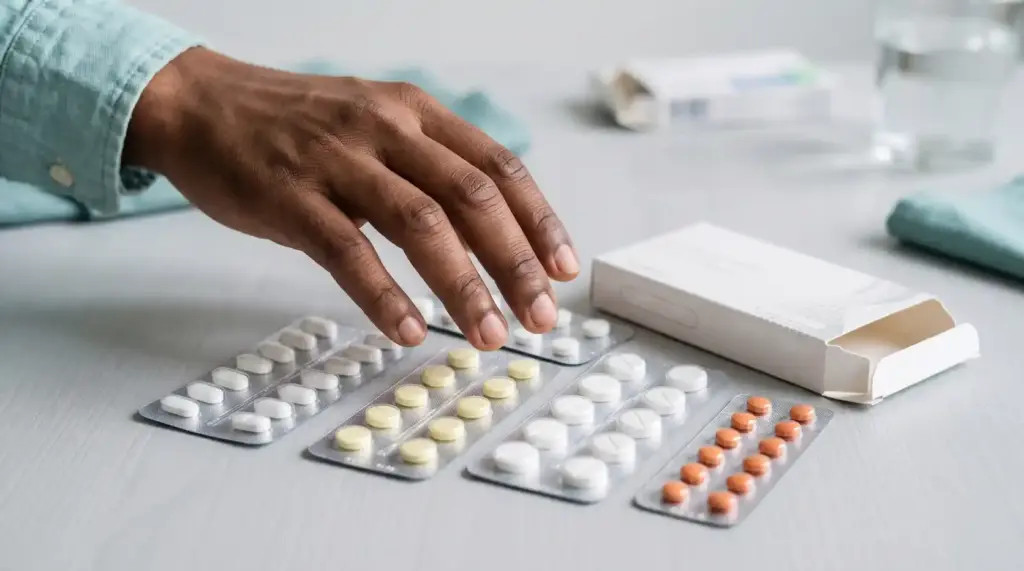
Some of the medicines looked familiar.
Others did not.
A tablet might have a different color or shape. The packaging might look unfamiliar. A medicine might taste different from the one he remembered taking before.
To him, these differences mattered.
Perhaps this was a different manufacturer.
Perhaps the formulation had changed.
Perhaps the medicine had been stored badly.
Or perhaps it was not genuine.
The problem was that he could not tell.
A difference in appearance does not prove that a medicine is falsified. Legitimate medicines can differ between manufacturers and formulations.
At the same time, some falsified medicines can be extremely difficult to distinguish from genuine products by appearance alone.
WHO advises people who suspect a medicine may be falsified to discuss the concern with a pharmacist, doctor, or other healthcare professional and to report suspected products to the relevant medicines regulatory authority.
He could neither prove the medicines were fake nor prove that they were genuine.
And that uncertainty became part of the treatment problem.
Appearance alone cannot reliably establish the authenticity of a medicine.
A medicine that looks unfamiliar is not necessarily falsified, while a medicine that looks convincing is not necessarily genuine. Packaging, color, shape, taste, or appearance may raise a concern, but they cannot establish authenticity on their own
The Possibility of Fake Malaria Medicines
At this point, another possibility entered the story.
What if some of the medicines really were fake?
It was not an unreasonable concern.
WHO describes falsified medical products as those that deliberately misrepresent their identity, composition, or source. Substandard products are different: they are authorized products that fail to meet quality standards or specifications. Both can result in treatment failure and other harm.
The distinction matters because “fake” is not a precise medical or regulatory diagnosis.
A medicine could be falsified.
It could be substandard.
It could have been improperly stored.
It could be genuine but inappropriate for the patient’s condition.
Or the medicine could be perfectly genuine and the problem could lie somewhere else.
In this case, none of those possibilities could simply be assumed.
There was suspicion.
There was uncertainty.
But there was no laboratory confirmation that the medicines were falsified
“Fake medicine” is a common expression, but it is not a precise medical term.
Healthcare professionals and medicines regulators distinguish between several concepts that are sometimes grouped together as “fake medicines.”
- Falsified medicine: A medical product that deliberately misrepresents its identity, composition, or source.
- Substandard medicine: An authorized medical product that fails to meet established quality standards or specifications.
- Unlicensed or Unregistered medicine: A medical product that has not been authorized by the relevant regulatory authority for the market in which it is being marketed or used.
These categories can overlap in practical risk but are not interchangeable. WHO distinguishes them because the underlying causes and regulatory responses differ.
In this case, these terms matter, because the medicines were suspected of being fake, but their authenticity was never confirmed.
SEE ALSO: Falsified medicine; Substandard medicine; Quality-assured medicine; Medicine authentication; Unregistered medicine
Why Medicine Quality Matters
WHO describes substandard and falsified medical products as a global public-health problem. Such products can result in treatment failure, contribute to antimicrobial resistance in some circumstances, and undermine confidence in medicines and healthcare systems.
For malaria, the implications can be particularly serious because effective treatment needs to reach the patient promptly. A medicine that is substandard or falsified can therefore do more than fail to treat the infection; it can contribute to lost time while the patient believes treatment is already underway.
Every New Medicine Reset the Question
Every time he started another medicine, the same questions had to be asked again.
What exactly had he taken before?
How much had he taken?
For how long?
Had he completed the previous treatment?
Was the dose appropriate?
Had he taken anything else alongside it?
And was the new medicine being started because there was a clear clinical reason, or simply because the previous medicine had not produced the improvement he expected?
With each change, the treatment history became more complicated.
A new medicine did not erase the medicines that came before it.
It added another layer to the story.
This matters because apparent treatment failure has several possible explanations. The diagnosis may need to be reconsidered. The treatment may have been inappropriate or inadequately dosed. The patient may not have completed the regimen or may not have absorbed it properly. Drug resistance, medicine quality, reinfection, or another illness may also need to be considered.
So every new medicine should not simply answer the question:
“What should I take next?”
It should first answer:
“Why did the previous treatment not produce the expected result?”
That distinction could have changed the course of his illness.
Changing medicines is not the same as changing the diagnosis.
When a treatment appears not to be working, repeatedly switching medicines without reassessment can obscure the original treatment history and make it harder to determine what is actually happening.
When “Stronger” Becomes the Goal
There is another idea that often enters the mind when treatment appears to fail:
Maybe I need something stronger.
It is an understandable thought.
If one tablet did not work, perhaps two will.
If tablets did not work, perhaps an injection will.
If one brand did not work, perhaps another brand will.
But malaria treatment does not work according to a simple scale of weak to strong.
The goal is not to find the medicine that feels most powerful.
The goal is to receive the right treatment, at the right dose, for the right duration, for the illness that is actually being treated.
An injection is not automatically stronger than a tablet. A more expensive brand is not automatically better. And taking several antimalarials does not necessarily provide more effective treatment.
Sometimes, the safest treatment decision is not to add another medicine.
It is to stop and reassess.
The Injection
Eventually, he was given an injection.
Perhaps this, he thought, would be different.
Injections carry a certain psychological weight. They can feel more serious than tablets and, to some patients, seem like proof that they have finally received something “strong enough.”
But an injection is not automatically a stronger or better malaria treatment.
Injectable antimalarials have an important role in severe malaria. WHO recommends parenteral artesunate for severe malaria, with patients subsequently completing an appropriate oral ACT once they can tolerate oral treatment. This is very different from using an injection simply because an uncomplicated malaria infection has not improved as quickly as expected.
The question is therefore not:
“Is it an injection?”
It is:
“Is it the right medicine, for the right patient, at the right dose, through the right route, for the right reason?”
An injection also does not solve the problem of an uncertain medicine supply. A parenteral product can still be inappropriate, improperly handled, or of uncertain quality.
And if the underlying problem is an incorrect diagnosis, treatment interruption, inadequate dosing, drug resistance, or another illness occurring alongside malaria, changing the route of administration does not necessarily solve it.
For this patient, the injection may have felt like escalation.
But medically, escalation should mean better-targeted care, not simply a more dramatic-looking medicine.
An injection is a route of administration, not a measure of how powerful a medicine is.
Injectable artesunate is an important treatment for severe malaria, but its use is guided by the patient’s clinical condition. For uncomplicated malaria, treatment should follow the appropriate recommended regimen rather than using an injection simply because it appears stronger.
When injectable malaria treatment is appropriate
WHO recommends injectable artesunate or, where appropriate, another recommended parenteral antimalarial for severe malaria. Once a patient with severe malaria can tolerate oral medicines, treatment should be completed with an appropriate ACT. Uncomplicated P. falciparum malaria is treated with an appropriate oral ACT rather than an injectable medicine simply because symptoms persist.
But Were the Medicines Really the Problem?
It was tempting to blame the medicines.
Some of the products looked different from what he was accustomed to. Some tasted different. He had obtained medicines from different sources, and he had changed treatments several times. The possibility of fake malaria medicines was therefore understandably on his mind.
But suspicion is not diagnosis.
Persistent symptoms after starting malaria treatment do not, by themselves, prove that a medicine was fake.
The original diagnosis may need to be reassessed. The malaria may be more severe than initially appreciated. The dose may have been inappropriate. The patient may not have absorbed the medicine properly, perhaps because of vomiting. He may not have completed a regimen. The parasite may have reduced susceptibility to a particular medicine. He may have acquired malaria again. Or another illness may have been causing some of his symptoms.
And there is another complication: once several different medicines have been taken, it can become difficult to reconstruct exactly what happened.
Which medicine was taken first?
At what dose?
For how many days?
Was the full regimen completed?
What was taken afterward?
Were medicines combined?
Were any doses repeated?
Were injections given?
By this point, the question is no longer simply:
“Why isn’t the malaria getting better?”
It becomes:
“What exactly has this patient received, and what is happening now?”
That is why apparent treatment failure calls for clinical reassessment rather than automatically moving to another antimalarial.
Treatment failure should be investigated, not assumed.
When malaria symptoms persist or worsen, a clinician may need to reassess the diagnosis, disease severity, treatment regimen, adherence, absorption, medicine quality, and other possible causes of the patient’s illness.
A suspected falsified medicine is one possible explanation, but it should not become the explanation simply because the patient has not improved as expected.
The Young Adult Who Was Supposed to Be Less Vulnerable
This is an important part of the story.
When we talk about people at particularly high risk from malaria, we often think of young children, pregnant women, older adults, or people with serious underlying illnesses.
This patient did not fit the picture that might immediately make someone think:
“This person is especially vulnerable.”
He was young.
He was not known to have a chronic illness.
He was not pregnant.
He was not elderly.
But vulnerability is not always a characteristic of the person.
Sometimes, it is a characteristic of the situation.
A person can be young and otherwise healthy and still become vulnerable when:
- effective treatment is delayed;
- medicines are obtained from unreliable sources;
- multiple regimens are taken without adequate supervision;
- medicine quality is uncertain;
- treatment is repeatedly changed; or
- worsening illness is interpreted as a reason to keep trying different medicines.
WHO notes that everyone can be exposed to substandard and falsified medical products, while risk is increased in circumstances such as weaker health systems, disrupted supply chains, and purchasing from unauthorized sources.
The lesson is important:
Being young and otherwise healthy does not make a person immune to a dangerous treatment pathway.
Vulnerability is not determined by age alone.
When people think about vulnerability to malaria or poor-quality medicines, attention often goes first to groups such as young children, pregnant women, older adults, and people with certain underlying illnesses. But vulnerability can also arise from the circumstances in which medicines are obtained and used.
WHO identifies substandard and falsified medical products as a global problem and notes that risks can increase where health systems and supply chains are weak, disrupted, or poorly regulated, and where medicines are obtained through unauthorized or unreliable sources.
A young, otherwise healthy adult can therefore become vulnerable when effective treatment is delayed, medicines are obtained from uncertain sources, or treatment is repeatedly changed without appropriate clinical reassessment.
When the Patient Becomes His Own Pharmacist
There is a quiet transformation in stories like this.
The patient begins by asking:
“What medicine should I take?”
Eventually, he is deciding:
“Which medicine should I try next?”
That is a very different position.
He is no longer simply following a treatment plan.
He is constructing one.
Brand by brand.
Tablet by tablet.
Injection by injection.
And because he does not have the tools to determine whether each product is genuine, appropriate, correctly dosed, or compatible with what he has already taken, each decision contains another layer of uncertainty.
This is not simply a story about patient behavior.
It is also a story about the environment in which those decisions are being made.
When people can easily encounter medicines from multiple sources, when quality assurance is difficult to see from the outside, and when advice comes from many directions, the patient may be left trying to assemble a treatment plan from fragments.
There is also an important misconception about over-the-counter (OTC) medicines: being available without a prescription does not mean that a medicine is automatically appropriate for self-medication.
OTC medicines can be useful when used appropriately and according to their instructions. But they can still cause adverse effects, interact with other medicines, mask symptoms, or be inappropriate for a particular illness. The risks become greater when someone is already taking several medicines or is using an OTC product to treat a condition that has not been properly assessed.
“Available without a prescription” does not mean “take whenever you think you need it.”
When the patient becomes his own pharmacist, every decision contains another layer of uncertainty.
What exactly has he taken?
A medicine does not become harmless simply because it can be purchased without a prescription.
Over-the-counter medicines can be appropriate and useful when used according to their instructions and for suitable conditions. However, they can still cause adverse effects, interact with other medicines, be unsuitable for particular patients, or mask symptoms that require professional assessment.
The risk becomes more complicated when a person is already taking several medicines or begins using an OTC product to treat an illness without knowing whether it is appropriate.
“Available without a prescription” does not mean “appropriate to take without thought.”
He Tried Herbs
Eventually, the tablets were no longer the only things he was trying.
He tried herbs.
Perhaps someone told him that a particular preparation had worked for them. Perhaps it was something traditionally used for fever. Perhaps, after several medicines had failed to produce the improvement he wanted, there seemed to be little harm in trying something different.
To him, it may not even have felt like adding another medicine.
It was simply herbs.
But the body does not necessarily make that distinction.
Herbal products are not automatically safe simply because they are natural. They can contain biologically active substances that may interact with conventional medicines, and their use should be disclosed to a healthcare professional when someone is taking other medicines.
The concern is not that every herb is harmful or that every herbal product will interact with every medicine. The problem is that the ingredients, doses, and potential interactions of some products may be uncertain or poorly studied.
And in his case, there was already another problem.
There were now several different medicines in the story.
Prescription medicines.
Over-the-counter products.
Injections.
And herbs.
The more treatments he added, the harder it became to reconstruct exactly what he had taken, in what doses, and in what sequence.
The question was no longer simply:
“Which medicine will cure the malaria?”
It was becoming:
“What exactly is this patient taking?”
“Natural” does not mean interaction-free.
Herbal medicines and other botanical products can contain biologically active substances that may interact with prescription or over-the-counter medicines. Some interactions may increase a medicine’s effects or side effects, while others may reduce its effectiveness. For many herbal products, however, the available evidence about specific interactions remains limited or uncertain.
The important question is not whether a product is “natural.”
It is what the product contains, what it does in the body, and what else it may interact with.
What Could Have Broken the Cycle?
Perhaps the most important intervention would not have been another antimalarial.
It might have been someone saying:
Stop.
Stop changing medicines.
Stop adding another product.
Stop assuming that the next brand will be stronger.
Come back.
Let us establish what you have already taken.
Let us assess you again.
Let us determine whether you still have malaria parasites and whether the illness has become severe.
Let us establish exactly what medicines you have taken, in what doses, and for how long.
And, where there is a genuine concern about medicine quality, let us investigate that concern rather than guessing.
Sometimes the most important intervention in a complicated treatment story is a pause.
The Hidden Cost of Fake Malaria Medicines
The consequences of fake malaria medicines can extend far beyond the money spent on them.
If a falsified antimalarial contains too little of the active ingredient, contains the wrong ingredient, contains no effective antimalarial ingredient, or is otherwise unsuitable, the patient may continue to carry the infection while believing that treatment is already underway. Substandard and falsified medical products can cause treatment failure, prolong illness, and in some circumstances contribute to antimicrobial resistance.
The danger is therefore not merely:
“The medicine didn’t work.”
It is:
“The patient lost time while believing that he was being treated.”
And when several different products are taken in succession, there may be additional risks from inappropriate dosing, adverse effects, drug interactions, or simply losing track of what has already been taken.
The harm can therefore become larger than the original medicine problem.
Poor-quality medicines can create harm beyond the failure of a single treatment.
WHO identifies substandard and falsified medical products as a major global public-health problem. Such products can result in treatment failure, prolong illness, cause direct harm, and undermine confidence in medicines and healthcare systems. In some circumstances, they may also contribute to antimicrobial resistance.
For malaria, the consequences can be particularly serious because effective treatment needs to reach the patient promptly. When a patient receives a medicine that is ineffective or of uncertain quality, valuable time may be lost while the infection remains inadequately treated.
The danger is therefore not only what may be inside the medicine. It is also the time lost while the patient believes effective treatment is already underway.
Changing antimalarials because symptoms have not disappeared quickly
Feeling unwell after starting treatment does not automatically mean that the medicine has failed.
A common mistake is to abandon one regimen and immediately start another, or combine several medicines, without determining why the patient has not improved.
That can make treatment more complicated and may expose the patient to unnecessary medicines.
Do not add, switch, or repeat antimalarial treatment simply because another product appears stronger or because symptoms have not disappeared as quickly as expected. Seek clinical reassessment instead.
The Days That Disappeared
There was something else accumulating besides medicines.
Time.
One day passed.
Then another.
The fever remained.
Another medicine appeared.
Then another.
Somewhere between the first treatment and the next, the days began to blur together.
He was taking medicines, but treatment itself had become uncertain.
That distinction is important.
The danger of a poor-quality or inappropriate medicine is not limited to what the tablet contains. It can also be the time lost while the patient believes that effective treatment is already underway.
For malaria, that lost time can matter. WHO emphasizes prompt treatment with effective and safe antimalarial medicines to achieve cure and prevent life-threatening complications.
The question is not simply whether a patient has taken a medicine.
It is whether the patient has received effective treatment soon enough.
And that is what makes this story more than a story about tablets.
It is a story about time.
What This Case Teaches Us
This is not a story about a foolish patient.
It is not a story about a young man who did not care about his health.
It is not even necessarily a story about fake medicines.
It is a story about what happens when a genuine illness meets uncertainty about treatment.
The malaria parasite was real.
His symptoms were real.
His desire to recover was real.
The medicines were real objects in his hands.
But the certainty that those medicines were genuine, appropriate, and sufficient was missing.
And when certainty disappears, people often compensate with action.
Another tablet.
Another brand.
Another prescription.
Another injection.
Another day.
Another hope.
The Human Problem Behind the Medicine Problem
A falsified medicine does more than deceive a patient about a product.
It can deceive them about progress.
The patient thinks:
I am being treated.
When in reality, effective treatment may still be waiting.
That is why the harm of fake medicines cannot be measured only by what is inside the tablet.
Sometimes the greatest harm is the time they steal while pretending to give treatment.
And this is where the story becomes bigger than one patient.
A person does not have to be reckless to become caught in a dangerous treatment cycle.
They may simply be sick.
They may be frightened.
They may want to recover quickly.
They may trust the person selling the medicine.
They may trust the appearance of the package.
They may believe that an injection must be stronger.
They may believe that changing medicines is better than waiting.
And they may never know that the most important decision available to them was to stop and seek reassessment.
The Question That Remains
He had malaria before.
He knew what malaria felt like.
He knew he needed treatment.
He kept looking for it.
But somewhere between the positive test and the next tablet, treatment became a guessing game.
And the longer the guessing continued, the more dangerous the game became.
Perhaps that is what makes this case unsettling.
It was not his first malaria.
But when an illness that is treatable becomes entangled with uncertain medicines, repeated treatment changes, self-medication, and lost time, even a familiar disease can become something far more dangerous.
It could have been his last malaria.
Not because malaria was inevitably fatal.
But because the treatment pathway had become dangerous enough to threaten the outcome.
And that leaves us with the question:
How many days can a person lose while trying to find a medicine they can trust?
The Medical Context
Malaria should be diagnosed and treated promptly with an appropriate, quality-assured antimalarial regimen. WHO recommends appropriate ACTs for uncomplicated P. falciparum malaria and parenteral treatment for severe malaria, followed by an appropriate oral regimen once the patient can take oral medicines.
Persistent or worsening symptoms after treatment should prompt clinical reassessment rather than an escalating sequence of self-selected antimalarial medicines. The clinician may need to reconsider the diagnosis, disease severity, treatment regimen, adherence, absorption, medicine quality, or other causes of the patient’s symptoms.
A suspected falsified medicine is therefore an important possibility to investigate, but it should not automatically be assumed to be the cause of treatment failure.
WHO recommends that people who suspect a medicine may be substandard or falsified discuss the concern with a pharmacist, doctor, or other healthcare professional and report suspected products to the relevant national medicines regulatory authority.
Seek urgent medical care if someone with suspected or confirmed malaria develops worsening symptoms, confusion, unusual drowsiness, difficulty breathing, repeated vomiting, inability to drink or take medicines, seizures, collapse, severe weakness, or other signs of severe illness.
Anyone who has already taken several different antimalarial products should tell the healthcare professional exactly what was taken, including prescription and over-the-counter medicines, tablets, capsules, injections, herbal or traditional remedies, supplements, doses if known, and when each product was taken.

No comments yet
Be the first to share your thoughts, clinical perspective, or questions on this topic.