


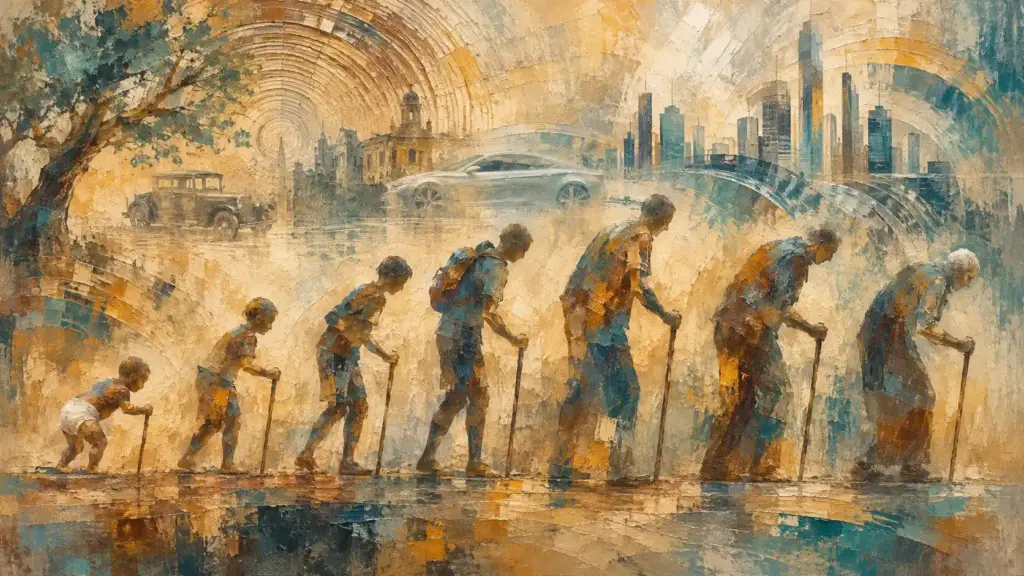
I remember when old people
were simply old.

They walked too slowly,
sat too long,
complained about the weather,
and fell asleep
in the middle of conversations.

Their stories were always
from another time.

Their music was too loud
or too strange,
their clothes too peculiar,
their opinions too stubborn.

We wondered why they kept
the things they never used,
why they repeated themselves,
why they worried so much
about tomorrow.

We thought they had lived enough.

We thought they had seen everything.

We thought old age
was a country
we would visit someday.

But someday
has a way of arriving
without knocking.

The knees begin to negotiate
with the stairs.

The eyes request more light.

Names disappear
from the tip of the tongue,
and familiar faces
take an extra moment
to become familiar.

The mirror becomes
an unreliable witness.

And somewhere between
the photographs of yesterday
and the appointments of today,
we discover
that the old people
we once knew
have become us.

Or perhaps
we have become them.

We begin to understand
why they kept those old things.

Why certain songs
made them quiet.

Why they called
just to hear a voice.

Why they told the same stories
to people who had heard them
a hundred times.

Perhaps they were not repeating
the past.

Perhaps they were trying
to keep it.

We used to count the years
until we were grown.

Now we count them
by who is still around.

The birthdays we remember.

The faces we no longer see.

The chairs that remain empty
at familiar tables.

Ageing is not always
the dramatic collapse
we imagined.

Sometimes it is simply
the gradual discovery
that the world has continued
without asking us
to keep up.

That the young have new words
for old things.

That yesterday's revolutionaries
have become today's conservatives.

That the things we once swore
would never change
have changed anyway.

And still,
there is something tender
about arriving here.

About surviving
the versions of ourselves
we thought were permanent.

About learning
that a slower step
does not necessarily mean
a smaller life.

Perhaps growing old
is not becoming less.

Perhaps it is becoming
more acquainted
with what remains.

More patient
with the unfinished.

More forgiving
of the forgotten.

More grateful
for the ordinary miracle
of another morning.

For a familiar voice.

For a hand that still reaches
for ours.

For the quiet privilege
of being here
to witness another day.

I used to look at old age
from the outside.

Now I look through its windows.

And I wonder
if the old people
I once hurried past
were simply waiting
for the rest of us
to understand.

Perhaps they knew
something we had yet to learn:

That life does not stop
when youth leaves.

That there are still things
to discover,
people to love,
stories to tell,
and mornings to welcome.

One day,
without ceremony,
without warning,
without permission—

it became
my turn
to be old.
About This Reflection
My Turn to Be Old is a reflection on the quiet, often unexpected experience of aging. It explores the distance between how we once viewed older people and how we gradually begin to recognize ourselves in them. Through memories, changing bodies, familiar voices, and the passage of generations, the poem considers what it means to grow older in a world that keeps moving forward.
It is also a meditation on the things we carry, the people we lose, and the unexpected tenderness of reaching an age we once thought belonged to someone else. Above all, it challenges the idea that growing older means becoming less, reminding us that life continues to hold meaning, discovery, connection, and possibility beyond youth.
The Medical Context
Aging is a natural, lifelong process that gradually affects the body, brain, and the way people experience the world. Physical changes may include reduced muscle strength, changes in vision and hearing, decreased bone density, joint stiffness, and slower recovery from illness or physical exertion. Some people may also notice changes in memory, attention, or the speed at which they process information.
However, aging is not a uniform experience. People grow older differently, influenced by genetics, lifelong health, living conditions, lifestyle, social relationships, and access to healthcare. Growing older does not automatically mean becoming frail, dependent, or unwell.
The distinction between normal age-related changes and disease is particularly important. Occasional forgetfulness or taking longer to recall a name may occur with age, but significant memory loss that interferes with everyday activities should not simply be dismissed as part of aging. Dementia, including Alzheimer's disease, is not an inevitable or normal consequence of aging and warrants appropriate medical assessment.
The concept of healthy aging extends beyond the absence of disease. The World Health Organization describes it in terms of maintaining the functional abilities that enable people to meet their needs, remain mobile, build relationships, make decisions, continue learning, and participate meaningfully in society.
Ultimately, aging is not simply a measure of how many years a person has lived or how much physical capacity has changed. It is also about preserving dignity, independence, relationships, purpose, and the ability to continue finding meaning in everyday life.
Suggested Reading
For readers interested in exploring the science of aging and memory further, these resources offer additional perspectives:
-
WHO - Ageing and Healthy AgeingExternal Source


No comments yet
Be the first to share your thoughts, clinical perspective, or questions on this topic.