


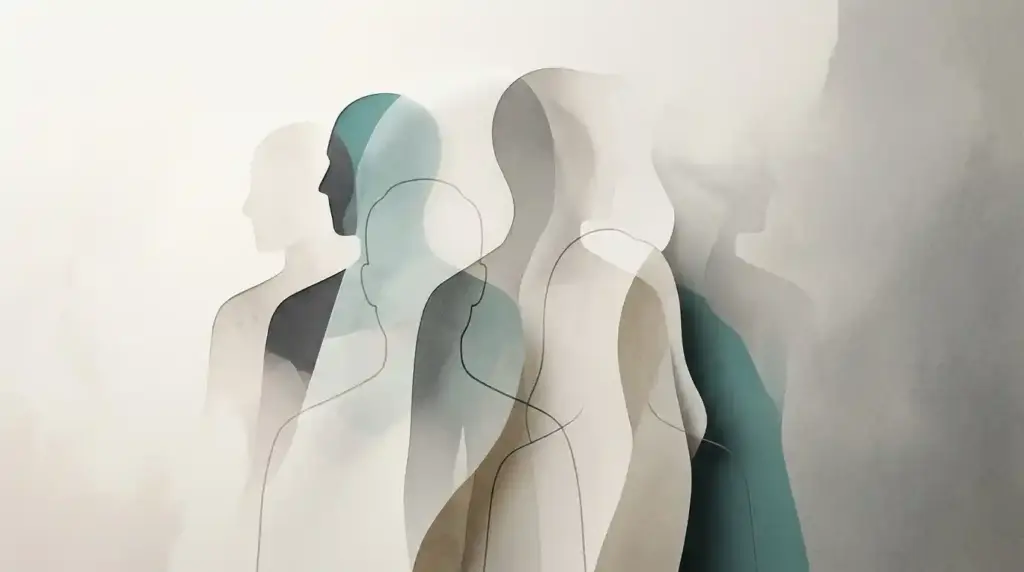
Somewhere between being known
and being forgotten,
there is a name we all share.

His name was John Doe.

Hers was Jane Doe.

Neither was born that way.
Neither was christened so.

Somewhere, someone once whispered a name
into their ears,
perhaps with tenderness,
perhaps with expectation.

Someone celebrated their arrival.
Someone held them
before the world had a chance to know them.

They had names.

They had histories.

Favorite meals, peculiar habits,
unfinished arguments,
people they loved,
people they disappointed,
places they called home.

They had mornings to look forward to,
nights they wished would never end,
and ordinary dreams
that seemed important enough to pursue.

They had lives.

But somewhere along the way,
their names became uncertain.

Perhaps he was found by the roadside,
with no identification in his pockets,
no familiar face to claim him.

Perhaps she arrived at a hospital,
unconscious,
her identity hidden
behind the silence of an unresponsive body.

Perhaps they were missing.

Perhaps they were dead.

Perhaps they were simply forgotten.

And so,
the world gave them new names.

John Doe.

Jane Doe.

Names that identify nobody,
yet accommodate everybody.

How peculiar
that someone can spend a lifetime
becoming somebody,
only to leave the world
as nobody.

We attach so much importance to our names.

We embroider them on uniforms,
print them on certificates,
carve them into monuments,
and defend them
with everything we have.

We spend years
trying to make them mean something.

We want to be remembered.

We want to leave something behind.

We want the world to know
that we were here.

Yet sometimes,
all that remains
is a placeholder.

A temporary arrangement of words
for a person
whose story we cannot tell.

And perhaps that is the most unsettling thing
about John and Jane Doe:

not that we do not know who they are,
but that they were once known
to someone.

Somewhere,
a mother may still be expecting a phone call.

A child may believe
their father is traveling.

A spouse may not yet have stopped
setting the table for two.

A friend may still wonder
why the messages stopped.

The world may have stopped asking
who John Doe was.

But someone might still be asking
where he is.

Someone may be searching for Jane,
unaware that she has already been given
another name.

Someone may still be looking,
still making calls,
still asking questions
that return no answers.

*Where are you?*

And somewhere else,
a person lies beneath a hospital sheet,
unable to tell anyone
who they are.

The clinicians know the condition
of the body,
but not the history
of the person inside it.

There may be no family to call,
no medical history to consult,
no familiar voice to explain
what the patient cannot.

Still,
the bleeding must be stopped.
The airway must be protected.
The heart must be given
every reasonable chance to keep beating.

The body deserves care
before the name is known.

Pain does not become less real
because the person experiencing it
cannot identify themselves.

Dignity does not depend
on a passport,
a familiar face,
or someone waiting
to claim us.

The absence of a name
is not the absence of a person.

And yet,
the world has many ways
of overlooking those
it cannot readily identify.

Some disappear into crowded cities.

Others are separated from their families
by conflict,
disaster,
migration,
illness,
or circumstances they never chose.

Some die far from home.

Others remain alive
but become strangers
in places where they once belonged.

Not all of them are called John Doe
or Jane Doe.

Some have names on official documents,
names their colleagues recognize,
names their families still speak.

And still,
they remain unknown
in the ways that matter.

Because anonymity
is not always the absence of a name.

Sometimes,
it is the absence of recognition.

We have our own versions
of John Doe and Jane Doe.

The people whose names we know
but whose stories we never care to learn.

The ones we reduce to statistics,
diagnoses,
photographs,
headlines,
and passing inconveniences.

The ones who occupy spaces in our world
without ever quite entering
our consciousness.

A patient becomes a bed number.

A person living on the street
becomes part of the scenery.

A worker becomes a pair of hands.

A refugee becomes a statistic.

A child becomes another case.

A death becomes another report.

We see them.

But do we recognize them?

We hear them.

But do we know them?

We learn what happened to them,
but do we ever wonder
who they were
before it happened?

Perhaps we do not need to know
every stranger's history
to treat them with dignity.

Perhaps the question is whether we can
acknowledge their humanity
without first establishing
their usefulness,
their status,
or their relationship to us.

It is easy to care
about people whose names we know,
whose stories resemble ours,
whose suffering we can imagine
ourselves experiencing.

It is harder to care
about those who remain unfamiliar.

Harder still
when their suffering interrupts our routines,
demands our attention,
or asks something of us
that we would rather not give.

And perhaps the distance
between being somebody
and being nobody
is not as wide as we imagine.

A moment of misfortune.

A misplaced document.

A severed connection.

A body without a familiar face.

A life without someone
to tell its story.

Sometimes,
it takes only a change in circumstances
for a person to become invisible
to a world that once knew
exactly where to find them.

Today,
we are John,
Jane,
and everything in between.

We are names waiting to be remembered,
stories waiting to be told,
lives whose significance
cannot always be established
by those who encounter them.

We are the people
whose absence might go unnoticed,
whose histories might be lost
in the noise of everyday life,
whose names might one day mean nothing
to anyone beyond the few
who still remember.

We are more vulnerable to being forgotten
than we care to admit.

Perhaps this is why
the unknown stranger deserves
more than our curiosity.

They deserve our restraint
when we are tempted to judge without knowing.

Our compassion
when we cannot understand.

Our care
when they cannot tell us
who they are.

Not because they might belong
to someone important.

Not because someone might be searching for them.

Not even because
we might one day find ourselves
in their position.

But because their humanity
does not begin
with our recognition.

It was there
before we arrived.

So, the next time you meet a stranger,
remember:

They were somebody
before they became somebody to you.

They had a life
before they entered your field of vision.

They carried a history
before you formed an opinion.

They possessed a worth
that neither your knowledge
nor your ignorance
could create or diminish.

And if the world should ever lose track
of who they are,
may it never lose sight
of the fact
that they were someone.

Because John Doe was somebody.

Jane Doe was somebody.

And somewhere,
beneath those borrowed names,
somebody is still waiting
to be found.

Perhaps their name will return to them.

Perhaps their story
will find its way home.

Perhaps the questions
will remain unanswered.

But even if the world never discovers
who they were,
their lives were never made meaningless
by the world's inability
to remember them.

Perhaps the greatest tragedy
is not to die without a name,
but to live
without ever being seen.
About This Reflection
John Jane Doe is a reflection on identity, anonymity, human dignity, and the lives that risk being forgotten. Through the familiar placeholder names John Doe and Jane Doe, it explores what happens when a person becomes a question rather than a story and why being unknown should never mean being overlooked. Moving beyond unidentified people in hospitals, morgues, and missing-person investigations, the reflection considers a quieter form of anonymity: the experience of being known by name but never truly seen. It asks us to look beyond labels, circumstances, and assumptions to recognize the humanity that exists before recognition and remains long after a name is lost.
The Medical Context
John Doe and Jane Doe are placeholder names used in some countries, particularly the United States, when a person's identity is unknown or needs to be withheld. In healthcare, an unidentified patient may temporarily be assigned such a name or another institutional identifier so that medical assessments, test results, treatments, and records can be documented and coordinated while efforts to establish the person's identity continue.
The inability to establish a patient's identity can create practical challenges. Clinicians may have limited access to medical history, medication records, allergies, or information from family members and caregivers. Depending on the circumstances, this uncertainty can complicate clinical decision-making and efforts to contact the people who know the patient.
However, an unknown identity does not diminish a person's entitlement to appropriate, respectful care. Emergency assessment and treatment should be guided by the patient's clinical needs, applicable professional standards, and local law, not by whether their name is known. Healthcare teams must also follow appropriate procedures for documenting unidentified patients, protecting confidential information, and helping establish identity when necessary.
The terminology and procedures vary across countries and institutions. John Doe and Jane Doe are not universal medical identifiers, and other names, numbers, or temporary identification systems may be used.
Ultimately, the medical significance of an unidentified patient extends beyond the missing information in a record. Every patient has a history, relationships, and a life beyond the clinical encounter. The task of healthcare is not merely to document the person accurately, but to provide care that respects their dignity even when their story is not yet known.



No comments yet
Be the first to share your thoughts, clinical perspective, or questions on this topic.