We are generous creatures.

Perhaps more generous than we know.

We leave pieces of ourselves
on door handles,
on drinking glasses,
on the seats we occupy,
on the hands we shake,
and the shoulders we lean upon.

We leave them in places
we may never visit again,
and on people
whose names we may never know.

A strand of hair.
A flake of skin.
A little saliva.
A microscopic fragment
of an otherwise ordinary day.

We shed ourselves
without ceremony,
without permission,
without even noticing.

And the world keeps our gifts.

A cup remembers the lips
that last touched its rim.
A comb gathers the histories
of different heads.
A barber's floor becomes
a quiet archive of strangers.
A door handle collects
the invisible signatures
of everyone who passed through.

Layer upon layer,
we write ourselves into the world.

And we are not the only donors.

Every living thing participates
in this curious exchange.

Plants release their biological traces.
Animals leave behind their fur,
their feathers, their cells.
Microorganisms release genetic material
into their surroundings.

The soil receives.
The water carries.
The air becomes a passage
for fragments of life.

Life is constantly leaving evidence of life.

Even when an organism is gone,
some of its genetic handwriting
may remain.

We inherit traces
we cannot identify,
carry signatures
we cannot read,
and encounter biological histories
we may never know existed.

Someone else's skin cells
may settle on our clothing.
A strand of another person's hair
may travel with us.
A stranger's biological signature
may accompany us
long after the stranger
has disappeared into the crowd.

We take.
We leave.
We exchange.

Not always by invitation.
Not always by affection.
Sometimes by accident.
Sometimes through the simple business
of being alive.

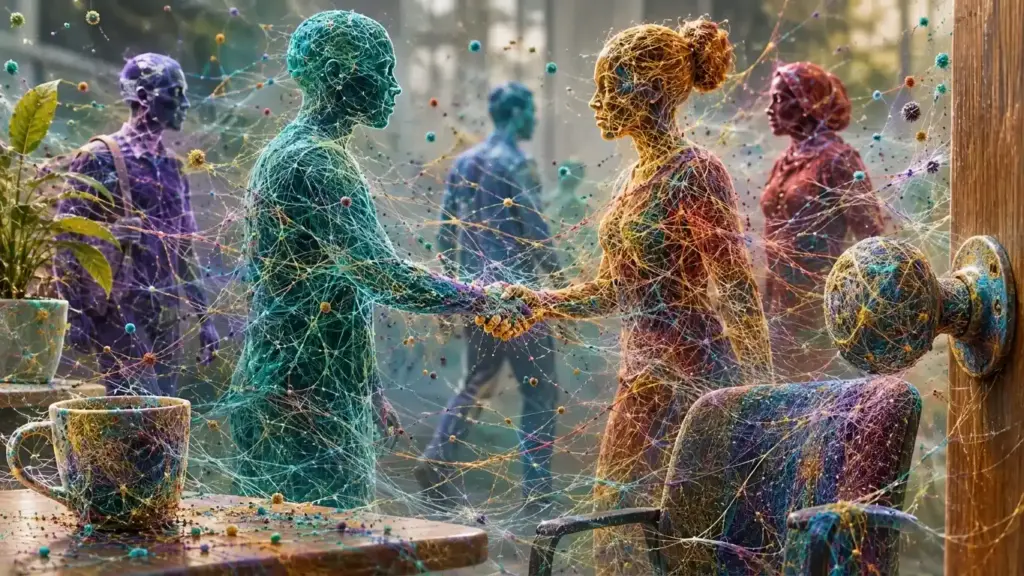
A handshake exchanges more
than warmth and courtesy.
An embrace brings bodies together,
but also their biological traces.
A kiss leaves more behind
than the memory of affection.

Even the most ordinary contact
can become an invisible meeting
between different biological worlds.

Yet, there is a distinction worth remembering.

Not every gift is a greeting.
Not every trace is harmless.

Some biological material may carry microbes.
Some may carry genetic evidence
without carrying any living organism at all.

DNA may remain
long after the cells that released it
have broken down.

A genetic trace is not necessarily
a living infection.
The presence of another person's DNA
does not automatically mean danger.

And so, we wash.
We clean.
We sweep away the evidence.

But life is persistent.

Another hand arrives.
Another strand falls.
Another cell settles.

And the exchange begins again.

We spend our lives
drawing boundaries around ourselves,
believing that our bodies end
where our skin ends.

Yet our biological presence
keeps crossing those boundaries.

Perhaps we are not as separate
as we imagine.

Perhaps every public space
is a gathering of invisible biographies.
Every shared object,
a meeting place for forgotten encounters.
Every ordinary surface,
a page on which life
has been quietly writing itself.

And when life finally departs,
when hands can touch no more,
when the body's endless renewal
comes to an end,

traces may remain.

In the soil beneath our feet,
in the objects we once touched,
in the spaces we once occupied,
and in the biological world
that continues without us.

We may never know
how far our smallest gifts travel.

Which surface will hold a trace?
Which current will carry a fragment?
Which invisible archive
will preserve a little evidence
of what once lived?

Perhaps that is
the beautiful absurdity
of being alive:

We are always leaving.
Always receiving.
Always becoming part
of something beyond ourselves.

And everywhere we go,
life quietly signs its name.
About This Reflection
The DNA Gift explores the invisible biological traces that living organisms leave behind as they interact with the world. Through ordinary encounters with shared objects, people, and environments, we continually shed and transfer microscopic biological material, including cells and fragments of DNA.
The reflection considers the curious exchange of biological traces between individuals and other living things, and how these traces may persist beyond the moments and places in which they were left. It offers a contemplative perspective on biological interconnectedness, the boundaries of the human body, and the extraordinary ways in which life leaves evidence of itself.
The Medical Context
The human body constantly releases biological material into its surroundings. Skincells are shed naturally, hair is lost, and microscopic traces of saliva and other bodily materials may be transferred through everyday contact.
This process has significance in several scientific and medical fields:
Touch DNA: DNA can sometimes be recovered from objects a person has handled, even when no visible biological material is present. The amount recovered depends on several factors, including the nature of contact, the individual, and the environment.
Forensic science: Biological traces can help investigators examine possible contact between individuals, objects, and locations. However, finding someone's DNA does not necessarily establish when, how, or under what circumstances it was deposited.
Environmental DNA (eDNA): Organisms release genetic material into their surroundings through shed cells, waste, secretions, and other biological material. Scientists can analyze this environmental DNA to detect species and monitor ecosystems.
Microbial exchange: Human contact with other people and the environment continually exposes the body to microorganisms. Some are harmless or beneficial, while others can cause infection.
Infection prevention: Hand hygiene, appropriate cleaning, disinfection, and other infection-control practices help reduce the transmission of disease-causing microorganisms.
An important distinction is that DNA is not the same as a living organism or an infectious agent. Genetic material may remain detectable after the cells that released it have broken down. Its presence alone does not establish that an infectious organism is present or that disease can be transmitted.
The biological traces we leave behind are therefore not all equivalent. Some are simply evidence of contact; others may contain viable microorganisms. Understanding that difference is important in forensic investigation, environmental science, and public health.
The DNA on an object may have arrived indirectly.
DNA can move from one person to another through intermediate surfaces or objects. For example, someone may acquire another person's DNA during a handshake and subsequently transfer it to a cup, table, or door handle. This is known as secondary DNA transfer. Consequently, finding someone's DNA on an object does not necessarily mean that the person touched it directly.
Suggested Reading
The science behind this reflection reaches beyond human contact. From forensic investigations that examine invisible traces of DNA to environmental studies that detect organisms through the genetic material they leave behind, these resources explore some of the ways science makes the unseen biological world visible.