


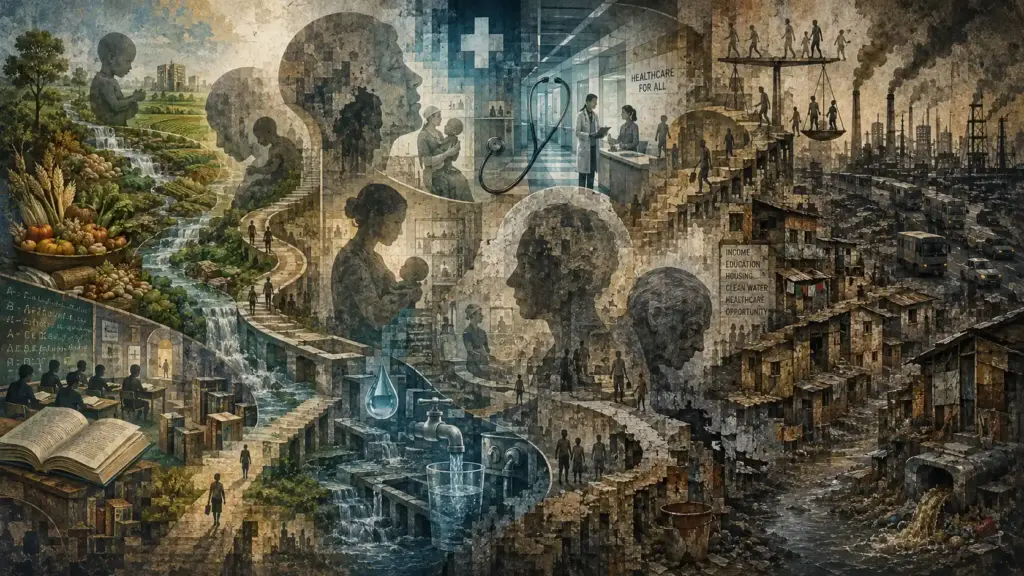
Somewhere in the world,
a child is born
into a century
that may have room
for a hundred birthdays.

The grandparents are still around
to argue over dinner,
to complain about aching knees,
to tell stories
that nobody has heard
for the hundredth time.

There is medicine
for the blood pressure,
medicine for the sugar,
medicine for the heart
that has been beating
since another century.

There is clean water
in the kitchen.

There is food
in the refrigerator.

There is a hospital
that does not require
a journey into uncertainty.

And somewhere else,
another child is born.

The same human species.
The same fragile lungs.
The same astonishing heart.

But here,
the water must be boiled
before it can be trusted.

Here,
a fever may become
a family emergency.

Here,
a mosquito carries
a sentence
that the child cannot read.

Here,
a mother may die
bringing life into the world.

Here,
an infection that elsewhere
requires a prescription
may require a funeral.

Here,
the medicine may be too expensive,
the hospital too far,
the doctor too few,
the road too dangerous.

And the child grows,
if fortunate enough to grow,
in a place where
fifty years
can sound like a reasonable expectation.

Fifty.

Not because the heart
was designed to stop
at fifty.

Not because the body
was made differently.

Not because the people
were born with less
of the desire to live.

But because life
has different prices
in different places.

Somewhere,
a man worries about
his cholesterol
at seventy-five.

Somewhere else,
another man never reaches
the age at which
cholesterol becomes
his greatest concern.

One has the luxury
of preventing tomorrow's disease.

The other must first survive
today's.

One grows old
with a pension,
a walking stick,
and grandchildren
who know his name.

The other leaves behind
a family still waiting
for the promises
that never came.

And we call it
life expectancy.

As though life
were a mathematical exercise.

As though the years
could be distributed
without consequence.

As though the place
where a child first cries
should determine
how long the world
will hear that cry.

We speak of longevity
as though it were
a personal achievement.

Eat well.
Exercise.
Sleep properly.
Avoid smoking.

Good advice,
certainly.

But what of the person
who cannot afford
the food we recommend?

What of the worker
whose lungs are filled
with the dust
of another man's prosperity?

What of the woman
who walks miles
for water
that may make her sick?

What of the child
whose future is shortened
before the first lesson
in healthy living?

How much of living longer
is discipline?

How much is inheritance?

How much is opportunity?

And how much
is simply the geography
of being born?

For averages
can conceal the faces.

They do not tell us
who died at five,
who was lost at thirty,
who never saw forty,
or who, against every expectation,
celebrated a hundredth birthday.

And within the same borders,
some grow old in comfort
while others grow old
fighting for the next meal,
the next treatment,
the next day.

Perhaps the greatest injustice
is not that some people
live to a hundred.

It is that others
never get the chance
to discover
how old they might have been.

A hundred years
should not be a privilege
of postcode,
passport,
or purchasing power.

For the heart
does not understand borders.

The lungs
do not recognize
national income.

And the desire
to see another sunrise
is not a luxury
reserved for the fortunate.

We cannot promise
everyone a hundred years.

Life has always been
unexpected.

But surely,
we can do better
than allowing birthplace
to decide
who gets the chance
to grow old.
About This Reflection
Life expectancy varies across populations, shaped by the conditions in which people are born, grow, work, and age. This reflection explores the inequalities behind those numbers, questioning why access to healthcare, nutrition, clean water, safety, and economic opportunity can influence not just the quality of life, but how long people get to live it.
The Medical Context
Life expectancy at birth is a population-level statistical estimate influenced by mortality patterns across different age groups. It reflects more than medical care: maternal and child health, infectious diseases, chronic conditions, nutrition, sanitation, education, income, environmental exposures, conflict, and social protection all contribute. National averages can also conceal substantial inequalities within countries and communities.
Understanding Life Expectancy
Life expectancy at birth is the average number of years a newborn would be expected to live if current age-specific mortality rates remained unchanged throughout their lifetime. It is a population-level statistical estimate, not a prediction of how long any particular individual will live.
It is influenced by conditions throughout life, including maternal and child health, infectious diseases, chronic illnesses, nutrition, sanitation, education, income, healthcare access, environmental exposures, and public safety.
Differences in life expectancy between populations often reflect inequalities in these underlying conditions and opportunities.
Suggested Reading
Explore these resources to understand how healthcare, socioeconomic conditions, and wider living environments influence life expectancy and the unequal opportunities people have to live longer, healthier lives.
-
Life expectancy and healthy life expectancyExternal Source
-
Social determinants of healthExternal Source
-
Life expectancy at birthExternal Source
-
Human Development ReportsExternal Source

No comments yet
Be the first to share your thoughts, clinical perspective, or questions on this topic.