


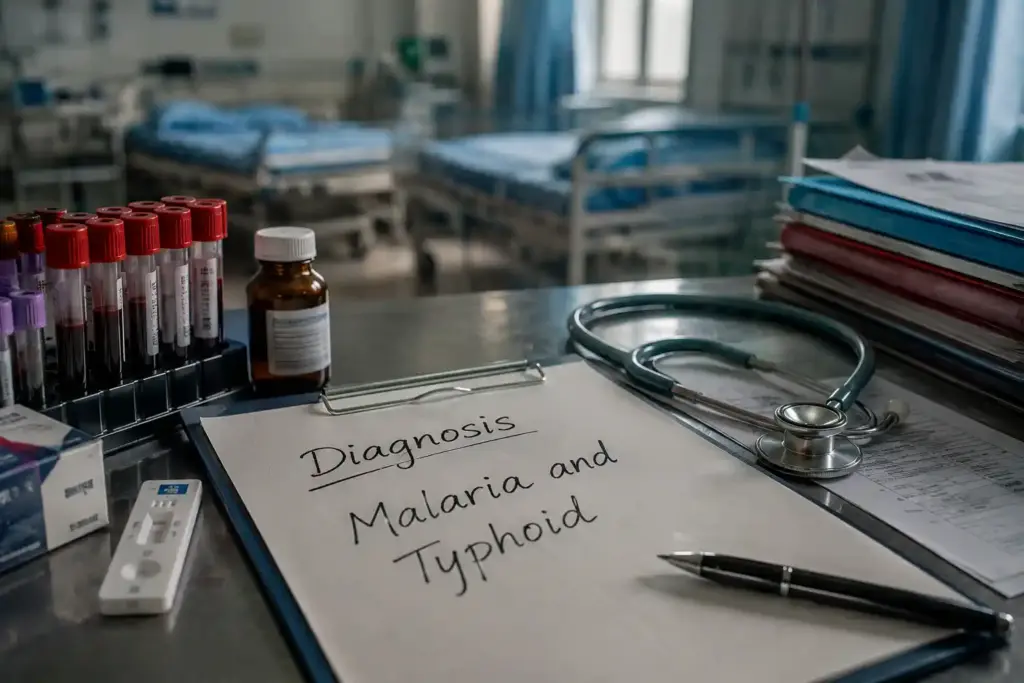
In many communities, a fever is often followed by two familiar diagnoses: malaria and typhoid. Sometimes both are reported after a single laboratory visit, and sometimes a headache is treated as further evidence that typhoid must be present. Yet malaria and typhoid are different infections, caused by different organisms, transmitted in different ways, and requiring different treatments. Although they can occur together, diagnosing both should require evidence for each. The routine pairing of these diagnoses raises important questions about how symptoms are interpreted, how laboratory tests are used, and whether some patients are receiving unnecessary medication because of assumptions rather than reliable diagnostic findings.
Malaria and Typhoid: Two Different Diseases

Malaria and typhoid fever are both potentially serious infectious diseases. They can cause fever, headache, weakness, and general discomfort. However, their similarities in presentation do not make them the same illness.
Malaria is a parasitic infection caused by Plasmodium species. It is transmitted primarily through the bite of an infected female Anopheles mosquito.
Typhoid fever, also called enteric fever, is a bacterial infection caused by Salmonella enterica serovar Typhi. It is usually transmitted through food or water contaminated by the feces of an infected person or carrier.
| Feature | Malaria | Typhoid fever |
|---|---|---|
| Causative organism | Plasmodium parasites | Salmonella Typhi bacteria |
| Main transmission route | Bite of an infected female Anopheles mosquito | Contaminated food or water |
| Common symptoms | Fever, chills, headache, fatigue, body aches | Prolonged fever, headache, fatigue, abdominal discomfort, constipation or diarrhea |
| Preferred diagnostic approach | Microscopy or malaria rapid diagnostic test (RDT) | Blood culture |
| Main treatment | Antimalarial medicines | Appropriate antibiotics |
| Prevention | Mosquito control, insecticide-treated nets, preventive medicines and vaccination where recommended | Safe water, sanitation, food hygiene and vaccination where recommended |
The distinction matters because a test confirming one infection does not automatically establish the presence of the other. A patient with malaria does not necessarily have typhoid, and a patient with typhoid does not necessarily have malaria.
Can a person have malaria and typhoid at the same time?
Yes. Both infections can occur simultaneously, particularly in regions where malaria and typhoid are endemic. However, the possibility of co-infection does not mean that every person diagnosed with malaria should also be diagnosed with typhoid. Each infection requires appropriate diagnostic evidence.
- Malaria is caused by Plasmodium parasites.
- Typhoid fever is caused by Salmonella Typhi bacteria.
- Their symptoms overlap, but their transmission routes, diagnostic methods, and treatments differ.
Can Malaria and Typhoid Really Occur Together?

Yes. A person can be infected with malaria parasites and Salmonella Typhi at the same time. This is known as co-infection.
The possibility is biologically reasonable, especially in communities where both infections circulate. A person living in a malaria-endemic area may be exposed to infected mosquitoes while also being exposed to unsafe food or water.
However, there is an important difference between the existence of co-infection and the frequency with which it is diagnosed.
A positive malaria test and a positive typhoid test do not necessarily establish that both infections are responsible for the patient’s symptoms. The reliability of the tests matters, as does the possibility that one result may reflect an incidental finding, previous exposure, or an inaccurate interpretation.
A systematic review published in 2021 examined malaria and typhoidal and non-typhoidal Salmonella co-infections. It found substantial differences in estimated co-infection rates depending on the diagnostic method used. In its analysis of febrile patients with malaria, the pooled prevalence of Salmonella infection was considerably higher when the Widal test was used than when blood culture or molecular methods were used.
These findings require caution. The review combined typhoidal and non-typhoidal Salmonella infections, and several analyses showed considerable variation between studies. Its results should not be interpreted as a definitive global estimate of confirmed malaria–typhoid co-infection.
Nevertheless, the difference between test methods highlights a central problem: the way an infection is diagnosed can influence how frequently it appears to occur.
A 2021 systematic review reported different pooled estimates of Salmonella infection among malaria patients depending on the diagnostic method:
- Widal test: approximately 31%.
- Blood culture: approximately 3%.
- Molecular methods: approximately 2%.
These figures relate to the review’s pooled analysis of typhoidal and non-typhoidal Salmonella, not exclusively confirmed Salmonella Typhi infection. The studies also varied substantially in their methods and settings. They should therefore illustrate diagnostic differences, not be presented as universal co-infection rates.
The Global Burden: Malaria and Typhoid Are Not Equally Distributed

Malaria and typhoid are both global health concerns, but their geographical distribution and patterns of transmission differ.
According to the World Health Organization’s World Malaria Report 2025, an estimated 282 million malaria cases and 610,000 malaria-related deaths occurred worldwide in 2024. The WHO African Region accounted for approximately 94% of cases and 95% of deaths.
Typhoid remains a significant public-health problem in areas where access to safe drinking water, sanitation, and food hygiene is inadequate. WHO’s published global estimates, based on 2019 data, put the annual burden at approximately 9 million cases and 110,000 deaths. These are historical estimates, not a newly measured 2026 global total.
The geographical overlap between malaria and typhoid is particularly relevant in parts of sub-Saharan Africa and South Asia. However, malaria is not equally common everywhere, and typhoid risk also varies according to local sanitation, water quality, and food-safety conditions.
This matters when interpreting a diagnosis. A person living in a malaria-endemic area has a different baseline probability of malaria infection from someone living in a country where malaria transmission has been eliminated. Similarly, the likelihood of typhoid depends on exposure and local epidemiology.
Malaria transmission occurs in multiple WHO regions, but the African Region carries the largest share of the global burden.
Typhoid remains concentrated in settings where safe water and sanitation are inadequate.
The likelihood of either infection should be considered in relation to the patient’s location, exposure history, and clinical presentation.
The Headache Misconception: Does Headache Mean Typhoid?

One of the most persistent misconceptions in the routine diagnosis of malaria and typhoid is the belief that a headache means a patient has typhoid, or that a headache accompanying malaria indicates a second infection.
This assumption is not supported by clinical evidence.
Headache is a nonspecific symptom. It can occur in malaria, typhoid fever, dengue, influenza, COVID-19, meningitis, and several other infectious and non-infectious conditions.
Headache is also a recognized symptom of uncomplicated malaria. The CDC lists headache, malaise, weakness, fever, chills, and gastrointestinal symptoms among the possible manifestations of malaria. WHO also identifies headache as one of the common early symptoms.
Typhoid fever can cause headache too. However, the presence of this symptom does not distinguish typhoid from malaria or establish that both infections are present. The CDC specifically notes that few clinical features reliably distinguish typhoid fever from other infectious diseases.
Why might the misconception persist?
Part of the explanation may be the way people experience illness.
Consider two people with malaria:
- One develops fever, chills, headache, and body aches.
- Another experiences intermittent tiredness, reduced energy, mild fever, or unusual sleepiness without a prominent headache.
Their symptoms may differ even though both have malaria. The severity and combination of symptoms are influenced by several factors, including the parasite species, parasite burden, previous exposure, age, immune status, and other individual characteristics.
In malaria-endemic settings, repeated exposure can lead to partial immunity. This does not necessarily prevent infection, but it can reduce the likelihood of severe illness. Some people may have mild symptoms, while others may have asymptomatic infection.
A person who has previously experienced malaria may therefore recognize a new episode differently from someone experiencing malaria for the first time. Neither the presence nor absence of a headache can reliably confirm or exclude malaria.
The same caution applies to typhoid. A patient with typhoid may have headache, but headache alone is not a diagnostic marker.
What about a headache that persists after malaria treatment?
A persistent headache deserves attention, but it should not automatically be interpreted as evidence of typhoid.
Possible explanations include:
- The malaria infection has not been adequately treated.
- The patient has another infection or illness.
- The headache is related to dehydration, poor sleep, or another associated problem.
- There is a complication requiring further assessment.
- The original diagnosis was incomplete or incorrect.
A clinician should reassess the patient rather than simply add a typhoid diagnosis based on the symptom.
If a person has malaria and complains of a headache, it means the person also has typhoid.
Headache can occur in malaria itself. It is also seen in typhoid and many other illnesses. It cannot independently establish a diagnosis of typhoid or co-infection.
A symptom is a clue, not a laboratory diagnosis. Clinical assessment should consider the complete history, examination findings, exposure risks, disease patterns, and appropriate investigations. A headache that is severe, persistent, associated with confusion, neck stiffness, seizures, or reduced consciousness requires urgent medical assessment.
Why the Symptoms of Malaria and Typhoid Are Easily Confused

Fever is one of the most common reasons people seek medical attention. Unfortunately, fever is not a disease-specific symptom.
Malaria and typhoid can both present with fever, headache, weakness, body aches, and general malaise. Other infections can produce similar symptoms.
The clinical presentation of malaria is variable. Some patients develop a recognizable combination of fever, chills, sweating, and headache. Others experience less typical symptoms, particularly in areas where repeated exposure has produced partial immunity.
Typhoid fever often has a more gradual onset. Fever may become progressively higher over several days and may be accompanied by headache, fatigue, abdominal pain, constipation, or diarrhea. Nevertheless, its presentation can overlap with other febrile illnesses.
The challenge is that no single symptom reliably separates these conditions.
| Symptom | Malaria | Typhoid |
|---|---|---|
| Fever | Common | Common |
| Headache | Common | Common |
| Fatigue or weakness | Common | Common |
| Chills | Common | May occur |
| Abdominal discomfort | May occur | Common |
| Diarrhea | May occur | May occur |
| Constipation | Not a defining feature | May occur |
| Progressive fever over several days | Possible | A recognized pattern |
The table describes possible clinical features, not a diagnostic scoring system. A patient should not be diagnosed with typhoid simply because abdominal symptoms or headache are present.
Other conditions must also be considered. Depending on the geographical setting, exposure history, and clinical findings, the differential diagnosis may include:
- Dengue fever
- Chikungunya
- Yellow fever
- Lassa fever
- Influenza
- COVID-19
- Urinary tract infections
- Pneumonia
- Meningitis
- Sepsis from different sources
- Leptospirosis
- Brucellosis
Some of these conditions require urgent treatment. Repeatedly treating every fever as malaria and typhoid can delay recognition of a more serious illness.
Malaria Diagnosis: What Does a Positive Result Really Mean?

Malaria should be diagnosed through appropriate parasite-based testing rather than symptoms alone.
The commonly used diagnostic methods include:
Microscopy
Microscopy involves examining a blood film under a microscope to identify malaria parasites.
It can help determine:
- Whether malaria parasites are present.
- The species of Plasmodium involved.
- The level of parasitemia, when the test is performed and reported appropriately.
Microscopy requires trained personnel, suitable equipment, and proper quality control.
Rapid Diagnostic Tests
Malaria rapid diagnostic tests detect specific parasite antigens in a blood sample. They are particularly useful where microscopy is unavailable or where a rapid result is needed.
However, RDTs have limitations. Their performance depends on the test type, parasite density, storage conditions, and correct use. Some tests may also remain positive for a period after successful treatment because certain parasite antigens persist in the blood.
Molecular Testing
Molecular methods such as polymerase chain reaction (PCR) can detect parasite genetic material and may be useful in selected situations, including species identification and research. They are not routinely required for every uncomplicated malaria case.
WHO recommends prompt testing by microscopy or RDT for suspected malaria before treatment. Where quality-assured testing is available, patients who test negative should be assessed for other causes of fever.
Does a positive malaria test always explain the fever?
Not necessarily.
In areas with intense malaria transmission, some people may carry malaria parasites without having symptoms. This is known as asymptomatic parasitemia. A positive test in such a person may not explain a separate episode of fever caused by another illness.
This does not mean that a positive malaria test should be ignored. It means that clinicians must interpret the result alongside the patient’s symptoms, clinical findings, and the likelihood of other illnesses.
The parasite density, test type, recent treatment history, and local transmission patterns may all be relevant.
- Assuming that every fever in a malaria-endemic area is malaria.
- Treating malaria without appropriate testing when quality-assured testing is available.
- Assuming that a positive malaria test automatically explains every symptom.
- Ignoring alternative causes of fever when a malaria test is negative or when the patient does not improve.
A malaria test should be interpreted in context. If symptoms persist, worsen, or do not follow the expected course after treatment, the patient should be reassessed for treatment failure, complications, or another diagnosis.
Typhoid Diagnosis: The Widal Test and Its Limitations
The Widal test is one of the most familiar investigations used in some parts of the world to diagnose typhoid fever.
It detects antibodies against certain antigens associated with Salmonella Typhi. However, it does not directly demonstrate the presence of the bacteria in the patient’s blood.
This distinction is important.
A positive Widal result does not necessarily mean that the patient currently has typhoid fever.

Why can the Widal test be misleading?
The Widal test has several limitations:
- Antibodies may be present because of previous exposure.
- Antibody levels may vary between individuals and geographical settings.
- Cross-reactions with other organisms may produce misleading results.
- A single antibody titer may not reliably distinguish current infection from previous exposure.
- Interpretation can vary according to laboratory methods, local baseline titers, and the threshold used.
The CDC does not recommend serological tests such as Widal for diagnosing typhoid because of their high false-positive rates. Blood culture remains the mainstay of diagnosis.
What is the preferred test for typhoid?
Blood culture is the preferred diagnostic method for confirming acute typhoid fever. It involves collecting a blood sample and attempting to grow Salmonella Typhi from it.
However, blood culture is not perfect. Its sensitivity can be affected by:
- The volume of blood collected.
- The stage of the illness.
- Previous antibiotic use.
- Laboratory procedures and culture methods.
More than one blood culture may be required to improve the likelihood of detecting the organism. In selected cases, other investigations may be considered.
Does a negative blood culture rule out typhoid?
Not necessarily. A negative result does not always exclude the infection, particularly if the sample was collected after antibiotics had been started or if the blood volume was inadequate.
The clinician must interpret the result in relation to the patient’s clinical condition and the quality of the investigation.
A positive Widal result should not be treated as definitive proof of active typhoid fever. Uncritical reliance on the test can lead to unnecessary antibiotic treatment and may distract from the actual cause of illness.
The Modern Trend: Why Are Malaria and Typhoid So Often Diagnosed Together?

The frequent pairing of malaria and typhoid diagnoses may arise from a combination of clinical, social, and health-system factors.
It is important to distinguish between a documented increase in disease and the normalization of a diagnostic practice. There is insufficient evidence to conclude that confirmed malaria–typhoid co-infection has increased globally over time. What is familiar in some settings is the practice of diagnosing both infections together, sometimes without adequate evidence for each.
Several factors may contribute.
1. Symptom-based assumptions
A patient with fever and headache may be presumed to have malaria and typhoid, even before appropriate investigations are completed.
This is particularly problematic when symptoms are treated as if they were specific to one disease.
2. Routine pairing of investigations
Some patients are routinely sent for malaria and Widal testing together, regardless of whether the clinical history supports both investigations.
When this becomes standard practice, the result may be two diagnoses rather than a careful interpretation of the evidence.
3. Misinterpretation of laboratory results
A positive Widal test may be interpreted as active typhoid, even when the result is not sufficiently reliable to establish the diagnosis.
Similarly, a positive malaria test may be assumed to explain every symptom without considering other possible causes.
4. Patient expectations
In some communities, patients may expect to receive a diagnosis of both malaria and typhoid when they present with fever, headache, or weakness.
A clinician may face pressure to provide a familiar diagnosis or prescribe medication that the patient expects.
5. Financial and commercial factors
The cost of investigations and treatment can influence healthcare decisions. In some circumstances, unnecessary investigations or prescriptions may be encouraged by financial incentives or poorly regulated practices.
However, these factors should be considered possible contributors rather than assumed explanations for every case.
6. Limitations in healthcare access
In settings where diagnostic facilities are limited, clinicians may have to make decisions with incomplete information. This can increase reliance on empirical treatment and less reliable tests.
These challenges are real, but they do not remove the need to interpret available evidence carefully.
A diagnosis can become familiar through repetition without becoming more accurate. The frequency with which malaria and typhoid are reported together should not be mistaken for proof that both infections are present in every patient.
There is a need for better population-based studies that distinguish laboratory-confirmed malaria–typhoid co-infection from diagnoses based on symptoms, Widal testing, or other less reliable methods. Without such evidence, claims that dual diagnosis is increasing globally should be avoided.
When Both Tests Are Positive: What Should Happen?

A patient may have a positive malaria test and a positive Widal test. The immediate temptation may be to conclude that both malaria and typhoid are present.
However, the results need to be interpreted separately.
A positive malaria microscopy or RDT result provides evidence of malaria infection, although the clinical relevance of that result must still be assessed.
A positive Widal result, on the other hand, does not reliably establish active typhoid fever.
The clinician should consider:
- Whether the malaria result is reliable and consistent with the clinical presentation.
- Whether the patient has risk factors or clinical features that raise suspicion of enteric fever.
- Whether a blood culture or other appropriate investigation is indicated.
- Whether another infection could explain the symptoms.
- Whether previous treatment may have affected the test results.
What if the patient has severe or persistent symptoms?
The presence of a positive malaria test should not prevent further investigation when the patient’s condition suggests another illness.
Similarly, a patient who does not improve after appropriate malaria treatment should not automatically be given antibiotics for presumed typhoid.
Persistent fever may reflect an incorrect diagnosis, inadequate treatment, drug resistance, a complication, or an entirely different illness.
For healthcare professionals:
- Confirm malaria with an appropriate parasitological test.
- Avoid treating a Widal result as definitive evidence of typhoid.
- Consider blood culture when enteric fever is clinically suspected.
- Reassess patients who fail to improve.
- Consider other causes of fever, especially when symptoms are severe or unusual.
For patients:
10. The Consequences of Unnecessary Antibiotic Use

One of the most important consequences of overdiagnosing typhoid is unnecessary antibiotic use.
Antibiotics are essential for treating bacterial infections such as typhoid fever. However, they do not treat malaria, which is caused by a parasite.
When antibiotics are prescribed without a reasonable indication, patients may experience avoidable adverse effects, including:
- Nausea and vomiting.
- Diarrhea.
- Allergic reactions.
- Drug interactions.
- Disturbance of the normal microbial balance in the body.
More importantly, unnecessary antibiotic use contributes to antimicrobial resistance.
Antimicrobial resistance occurs when microorganisms develop the ability to survive medicines that would ordinarily kill them or stop their growth. Resistant bacteria can make infections harder to treat and may require more expensive or less accessible medicines.
This is particularly concerning for typhoid fever because antibiotic-resistant strains of Salmonella Typhi have become a significant public-health challenge. WHO’s 2024 bacterial priority pathogens list includes fluoroquinolone-resistant Salmonella Typhi among high-priority pathogens.
The problem is not that antibiotics should be avoided when they are needed. The problem is using them when there is insufficient evidence that a bacterial infection requiring treatment is present.
Do not use antibiotics simply because a Widal test is positive or because a patient has a headache alongside malaria. Antibiotic treatment should be based on clinical assessment and appropriate diagnostic evidence.
Antibiotic resistance is not limited to the individual who takes an antibiotic unnecessarily. Resistant bacteria can spread between people and communities, making future infections more difficult to treat.
Not Every Fever Is Malaria or Typhoid
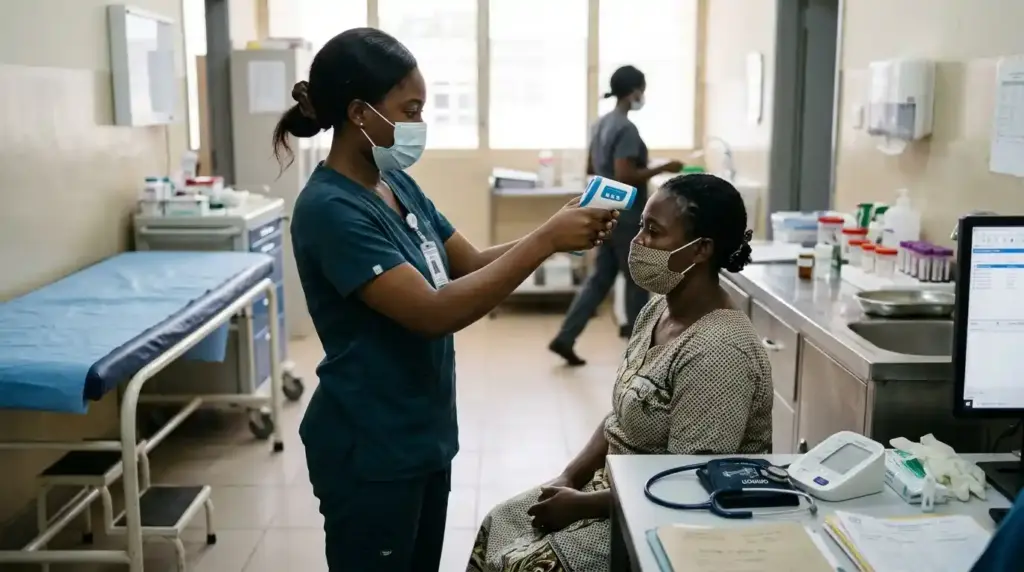
Malaria and typhoid are important causes of fever in many parts of the world, but they are not the only possibilities.
The correct approach to a patient with fever is to consider the person’s symptoms, medical history, geographical location, recent travel, exposure risks, and clinical examination.
Some alternative diagnoses may require urgent attention.
| Possible illness | Features that may raise suspicion |
|---|---|
| Dengue | Fever, headache, body aches, rash, sometimes bleeding |
| Chikungunya | Fever and prominent joint pain |
| Yellow fever | Fever, headache, muscle pain, sometimes jaundice |
| Lassa fever | Fever, weakness, gastrointestinal symptoms, possible bleeding or organ involvement |
| Influenza | Fever, cough, sore throat, body aches |
| COVID-19 | Fever, cough, sore throat, fatigue, or other respiratory symptoms |
| Urinary tract infection | Fever with urinary symptoms, though symptoms may be absent in some patients |
| Pneumonia | Fever, cough, chest pain, or difficulty breathing |
| Meningitis | Fever, headache, neck stiffness, altered consciousness |
| Sepsis | Evidence of serious infection with possible organ dysfunction |
The list is not exhaustive, and the symptoms are not diagnostic by themselves.
A patient with severe headache, neck stiffness, confusion, seizures, difficulty breathing, persistent vomiting, or reduced consciousness needs urgent medical assessment.
In particular, a diagnosis of malaria should not create false reassurance when the patient’s condition suggests a potentially serious alternative infection.
Seek urgent medical attention for fever accompanied by any of the following:
- Confusion, seizures, or reduced consciousness.
- Severe or rapidly worsening headache.
- Neck stiffness.
- Difficulty breathing.
- Persistent vomiting or inability to drink.
- Severe weakness, collapse, or signs of shock.
- Unusual bleeding or jaundice.
These symptoms may indicate severe malaria, meningitis, sepsis, or another serious condition. Do not delay assessment while trying to establish whether the illness is malaria or typhoid.
12. Toward Better Diagnosis and Rational Treatment

Reducing unnecessary malaria and typhoid diagnoses requires more than telling people to stop using the Widal test. It requires improvements in clinical reasoning, laboratory quality, patient education, and health-system practices.
For healthcare professionals
- Take a careful history and perform an appropriate clinical examination.
- Use malaria microscopy or RDTs to confirm suspected malaria.
- Do not diagnose typhoid from headache, fever, or a single Widal result.
- Use blood culture when enteric fever is suspected and testing is available.
- Reassess patients who do not respond to treatment.
- Consider other infectious and non-infectious causes of fever.
- Prescribe antibiotics only when clinically indicated.
For laboratories
- Maintain appropriate quality-control procedures.
- Ensure that diagnostic results are reported accurately.
- Avoid presenting a Widal titre as definitive proof of active typhoid.
- Encourage appropriate confirmatory investigations where available.
- Provide clear interpretation and limitations of tests.
For patients and communities
- Understand that malaria and typhoid are different diseases.
- Avoid assuming that headache means typhoid.
- Do not demand antibiotics simply because they were prescribed during a previous illness.
- Seek appropriate medical care for persistent or worsening symptoms.
- Follow recommended malaria prevention measures and safe food and water practices.
For policymakers and health systems
- Improve access to reliable diagnostic facilities.
- Strengthen laboratory training and quality assurance.
- Promote antimicrobial stewardship.
- Improve access to safe water and sanitation.
- Support surveillance and research into febrile illnesses and co-infections.
A good diagnostic process should answer three questions:
- What illness is most likely based on the patient’s history and examination?
- What investigation can reliably support or exclude that diagnosis?
- Does the result justify the proposed treatment?
The goal is not to order as many tests as possible. It is to select and interpret the right tests.
Research Gaps and the Need for Better Evidence

Although malaria and typhoid co-infection has been studied, important questions remain.
Many studies have used different diagnostic methods, different patient populations, and different definitions of co-infection. Some have relied heavily on Widal testing, while others have used blood culture or molecular methods.
This makes it difficult to compare results across countries and estimate the true burden of confirmed co-infection.
Future research should focus on:
- Reliable estimates of laboratory-confirmed malaria–typhoid co-infection.
- The contribution of Widal testing to typhoid overdiagnosis.
- The clinical significance of positive malaria tests in people with asymptomatic parasitemia.
- The causes of persistent fever after malaria treatment.
- The relationship between diagnostic practices and unnecessary antibiotic prescriptions.
- The availability and cost-effectiveness of improved diagnostic approaches in resource-limited settings.
Research should also distinguish between typhoidal and non-typhoidal Salmonella. They are not interchangeable diagnoses, and studies that combine them should be interpreted accordingly.
Key Takeaways
- Malaria and typhoid are different infections caused by different organisms.
- Both infections can occur together, but co-infection should not be assumed.
- Headache is a common, nonspecific symptom. It does not mean that a person has typhoid.
- Malaria can present with mild, unusual, or nonspecific symptoms, particularly in people with partial immunity from repeated exposure.
- A positive malaria test does not automatically explain every symptom.
- The Widal test has significant limitations and is not recommended by CDC as a reliable diagnostic test for typhoid.
- Blood culture remains the preferred method for confirming acute typhoid fever.
- Unnecessary antibiotics expose patients to avoidable harm and contribute to antimicrobial resistance.
- Persistent fever or worsening symptoms require reassessment, not automatic addition of another diagnosis.
- Good diagnosis depends on clinical assessment, appropriate investigations, and careful interpretation of results.
Conclusion: A Diagnosis Should Be Guided by Evidence, Not Habit
The simultaneous occurrence of malaria and typhoid is medically possible, but the routine diagnosis of both conditions without adequate evidence is a different matter. A headache does not establish typhoid, a positive Widal test does not necessarily confirm active infection, and a positive malaria result does not always explain every symptom a patient experiences.
The familiarity of these diagnoses in some communities should not make them automatic conclusions whenever someone presents with fever, weakness, or headache. Every patient deserves an assessment that considers the full clinical picture and uses reliable investigations wherever possible.
The consequences of inaccurate diagnosis extend beyond the individual patient. Unnecessary treatment increases healthcare costs, exposes people to avoidable medication risks, and contributes to antimicrobial resistance.
The answer is not to dismiss malaria or typhoid, nor to deny that they can occur together. It is to distinguish between what is possible, what is suspected, and what has actually been demonstrated.
A familiar diagnosis is not necessarily a correct diagnosis. Medicine must be guided by evidence, not habit.
Frequently Asked Questions
1. Can malaria and typhoid occur at the same time?
Yes. A person can have both infections simultaneously. However, each diagnosis should be supported by appropriate clinical and laboratory evidence.
3. Why are malaria and typhoid often diagnosed together?
Possible reasons include overlapping symptoms, routine ordering of malaria and Widal tests, misinterpretation of results, patient expectations, and limitations in access to reliable diagnostic services. However, this does not establish that both infections are present.
4. Can malaria cause a positive Widal test?
Some studies have reported positive Widal results among patients with malaria. However, this does not establish that malaria universally causes false-positive Widal results. The test has several limitations, including cross-reactivity and difficulty distinguishing current from previous exposure.
7. What is the most reliable test for typhoid?
Blood culture is the preferred method for confirming acute typhoid fever. Multiple cultures may be needed, and previous antibiotic use can reduce the chance of detecting the bacteria.
8. Does a positive Widal test confirm typhoid fever?
No. The Widal test is not sufficiently reliable to confirm active typhoid fever on its own. CDC does not recommend it because of its high false-positive rate.
9. Can typhoid be diagnosed without a Widal test?
Yes. Blood culture is the preferred method. Diagnosis also involves clinical assessment and consideration of the patient’s exposure history and other investigations.
10. Do antibiotics treat malaria?
No. Malaria is caused by a parasite and requires appropriate antimalarial medicines. Antibiotics treat bacterial infections, including typhoid fever, when prescribed appropriately.
11. What should I do if my fever persists after malaria treatment?
Seek medical reassessment. Persistent fever may indicate inadequate treatment, complications, another infection, or an incorrect initial diagnosis. Do not automatically assume that typhoid is responsible.
12. Is malaria and typhoid co-infection common worldwide?
Co-infection has been documented, particularly in some endemic settings. However, estimates vary considerably according to the population studied and the diagnostic methods used. There is no single reliable global figure that establishes how frequently confirmed malaria–typhoid co-infection occurs.
13. How can malaria and typhoid be prevented?
Malaria prevention includes mosquito control, insecticide-treated nets, appropriate preventive medicines, and malaria vaccination where recommended. Typhoid prevention includes safe drinking water, sanitation, food hygiene, and typhoid vaccination where recommended.
14. Why do I keep getting diagnosed with malaria and typhoid?
Repeated diagnoses of malaria and typhoid do not necessarily mean that you repeatedly have both infections. Malaria can recur through new mosquito-borne infections or, less commonly, treatment failure or recrudescence. However, repeated typhoid diagnoses may reflect reliance on the Widal test, which cannot reliably distinguish a current infection from previous exposure. Other illnesses can also cause recurring fever, headache, and weakness. If you keep receiving both diagnoses, ask your healthcare professional to reassess your symptoms and use appropriate investigations rather than automatically repeating the same treatment. A recurring diagnosis is not necessarily proof of recurring infection.




No comments yet
Be the first to share your thoughts, clinical perspective, or questions on this topic.